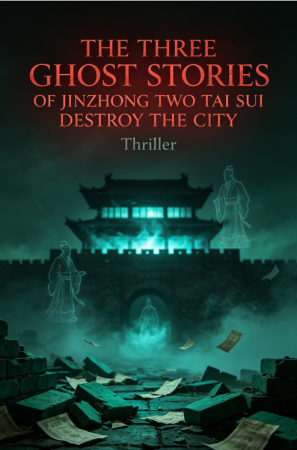
The Three Ghost Stories of Jinzhong Two Tai Sui Destroy the City
Author:Anonymous
Categories:Mystery and Supernatural
Tai Sui destroys the city (one) On August 23, 1966, in the Confucius Temple on Chengxian Street in Beijing, over a hundred Chinese writers, led by Lao She, were subjected to public criticism and struggle sessions. Thousands upon thousands of books of various kinds, both ancient and moder
The Three Ghost Stories of Jinzhong Two Tai Sui Destroy the City - Chapter 1
Tai Sui destroys the city
(one)
On August 23, 1966, in the Confucius Temple on Chengxian Street in Beijing, over a hundred Chinese writers, led by Lao She, were subjected to public criticism and struggle sessions. Thousands upon thousands of books of various kinds, both ancient and modern, Chinese and foreign, were burned in public, while countless irrational onlookers shouted and cheered. From then on, a large-scale cultural destruction campaign under the guise of "destroying the Four Olds" began in China. Numerous cultural relics and historical sites were destroyed by hammers, shovels, explosives, ignorance, and fanaticism. Such acts have occurred many times in history, but none have been as concentrated, frenzied, and bloody as this.
Although Weiyu City in Shanxi Province is far from the capital and the central government is in power, it was not immune to the impact of this event. However, unlike many other places, the entire city paid a heavy price for their blind and reckless participation.
No one expected it at first, or rather, no one could have imagined it would be so cruel!
1968, the year of Ji-You in the Chinese lunar calendar, late summer and early autumn.
At the foot of the south city wall, hundreds of men, shirtless, were working. Following an order from the county revolutionary committee, they were to demolish the only remaining section of the city wall. One man, with a red armband wrapped around his arm and a Mao Zedong portrait pinned to his muscular chest, was Wang Tiegen, the director of the leadership office for this "Destroy the Four Olds, Tear Down the City Wall, Welcome the New Air" campaign. He paced back and forth on the construction site, rushing to direct help wherever needed, loudly reprimanding anyone slacking off, and occasionally shouting slogans to boost morale. Perhaps destruction is human nature; the city wall, built with untold effort, had now been completely razed to the ground, leaving only the "barbican" inside the city gate remaining.
Those who have visited Pingyao might understand the meaning of "Wengcheng" (瓮城). As the name suggests, Wengcheng is a city wall shaped like an urn. This is a key difference between the city walls of various counties in Jinzhong and those of Beijing and Xi'an. Entering through the city gate doesn't immediately lead into the city; one must turn a corner within the "urn" to enter. Therefore, the south gate of the city wall faces east, a testament to the clever wisdom of our ancient Shanxi ancestors. Compared to a simple city wall, it offers greater security. Even if the enemy attacks through one gate, there's another gate for defense, and the enemy, trapped inside the "urn," is trapped—they can't escape. For thousands of years, Wengcheng has swallowed countless lives, and the blood of many has soaked this land. According to the *Weiyu County Annals*, whenever the enemy attacked the Wengcheng, boiling oil was immediately poured onto the top, causing the enemy "first to be scorched and their flesh to peel off; those following behind retreated in fear." After the enemy retreated, there was no time to clean up the battlefield, so "they threw fires and burned the corpses, the stench soared into the sky, the smoke drifted for miles, and it took several days to dissipate."
Because the barbican was the last line of defense for the entire city, it was built with a deep foundation, and the mortar between the bricks was mixed with glutinous rice soup and egg whites, making it as solid as an iron barrel. An entire morning passed, and they had only managed to remove a few loose bricks from the top of the wall. Seeing this, Wang Tiegen frowned, but he immediately thought of a solution. A former miner, he turned and ordered his men, "Go to the command post and get some explosives!"
Wang Tiegen circled the barbican, marking the areas he had chosen with white circles. He personally wielded the hammer, while another man held the chisel, and they began drilling holes. The others also joined in, chiseling holes in the circled areas. By the time the explosives arrived, all the holes were drilled. Wang Tiegen inspected them with satisfaction, then waved his hand and said, "Let's eat. After we eat, we'll level all this old stuff."
Little did he know that this was the last meal he would ever eat in this world!
---janeadam
Reply [3]: After lunch, Wang Tiegen led his men to the construction site again. He carefully filled each blast hole with explosives, inserted detonators, and connected the fuses. After everything was ready, he and the workers retreated to a safe distance, found cover, and then detonated the detonators.
After the deafening explosions, smoke filled the air, and the air was thick with choking dust. Wang Tiegen peeked out from behind his bunker. The once solitary but majestic barbican was now shattered, with pieces of the wall still collapsing. Wang Tiegen shouted excitedly, "Chairman Mao taught us to be determined, unafraid of sacrifice, overcome all difficulties, and strive for victory! Comrades, let's work harder!" The crowd roared and surged onto the construction site like a chaotic flock of sheep.
Zhang Yongwang's main task was to clear the center of the barbican. He stacked the intact blue bricks on one side and piled all the broken bricks on the other, waiting for the movers to carry them away. He was vigorously shoveling away the debris with his shovel when suddenly a protruding rock struck the blade, sending a shiver through his hands. The 30-year-old man, full of youthful vigor, angrily grabbed someone else's hoe and quickly pried open the rock. Muttering curses, he glanced at what lay beneath the rock and gasped, shouting, "Come and see!"
The workers all crowded around to watch the spectacle. Beneath the rock was a hollow hole. Because the opening was so small, and it was pitch black inside, they couldn't even tell how deep it was. Everyone speculated about what was below. One impatient man said, "What's there to guess? Let's dig it open and see!" Immediately, five or six men began digging. The opening grew wider and wider, and gradually they could see what was below. Everyone couldn't help but exclaim, "Wow!"
Beneath this ancient walled city, which has stood for a thousand years, there is actually a tomb.
The tomb was small, only about four or five square meters, surrounded by blue bricks carved with patterns of deer and cranes. On the north wall was a large yin-yang symbol. A solitary brown coffin lay in the center of the tomb. A tattered piece of yellow paper was pasted on the coffin lid, with incomprehensible symbols drawn in cinnabar on it.
A chill spread through the crowd; everyone fell silent and retreated. Fear was etched on every face. Some knelt first, then everyone else followed. On the vast construction site, a sea of people knelt in prayer.
Wang Tiegen rushed over, furious, shouting and kicking the workers, but not a single one stood up. Although they had unearthed many skeletons in the past few days, this was the first time they had found an intact grave. These simple-minded workers believed that digging up graves would bring retribution. So, despite Wang Tiegen's attempts to persuade them, no one was willing to continue digging. They all begged to be spared this section. Wang Tiegen shouted hoarsely for a long time, seeing no effect, he steeled himself, jumped into the grave with a "thump," and forcefully pried open the coffin lid.
Everyone present stared at him in disbelief.
---janeadam
Reply [4]: As soon as his hand touched the coffin lid, Wang Tiegen had a strange feeling. The coffin lid was neither gold nor wood, the surface was very rough, the structure seemed very tight, but it was not very heavy, and the elastic feel made people feel itchy and tingly. He put his hand under the coffin lid and lifted it up with a little force.
Without any creaking or groaning, the coffin lid was silently lifted, and a putrid stench rushed into Wang Tiegen's nose. He sneezed and forcefully moved the coffin lid to the side, revealing the contents of the coffin.
A skeleton lay in the coffin, tall and thin, with a whisk beside it. One or two fat rats squeaked and scurried away from the decaying coffin.
“What’s there to be afraid of? We proletarians dare to fight against heaven, against earth, and against man. Are we afraid of a dead reactionary secret society member?” Wang Tiegen cursed, pointing at the crowd above the grave. He then turned to the skeleton and said, “To cooperate with the revolutionary masses’ work of destroying the Four Olds, we’re going to move you somewhere. Bah, what bad luck.” He spat on his hand. He thought to himself that saliva could ward off evil. He bent down to gather the skeleton.
The skeleton seemed to grin. Wang Tiegen thought he was seeing things. He blinked and suddenly saw a dark red object clearly visible in the skull's mouth, against the backdrop of its white teeth.
"I've heard that in ancient times, when people died, they would put a gemstone in their mouths to prevent their bodies from rotting. Could this old Taoist's mouth contain such a gemstone?" Wang Tiegen thought to himself. He blocked others' view with his body and pretended to hug the skeleton, but his hand reached into the skull's mouth and pulled out the gemstone.
The moment Wang Tiegen held the object in his hand, he knew something was wrong. It lacked the coldness and weight of a gemstone; instead, it was warm and moist, gently wriggling in his hand. It felt as if it were—?
lick!
Yes, it's licking!
"How come the old Taoist priest is dead but his tongue is still alive? This is too strange, let's go up quickly!" These were Wang Tiegen's last thoughts in this world.
The people kneeling above the tomb only saw Wang Tiegen's back suddenly stiffen, and then he lay motionless on the coffin. Seeing that things were not going well, Wang Tiegen's subordinates disregarded their taboos and jumped into the pit one after another, lifted his body up, and turned him over to look at his face.
It was a completely withered face. In a mere instant, a mysterious force had completely drained Wang Tiegen's flesh and blood, leaving only a loose skin covering his bones. In his sunken eye sockets, his two eyeballs looked much larger than before, staring blankly at the crowd.
Chaos erupted as the crowd stirred in fear and unease. Someone shouted, "It's karma! Quickly fill the pit!" Everyone grabbed their tools and began throwing dirt into the pit. In no time, the grave was covered. Wang Tiegen's body was moved to a makeshift shed next to the construction site, and someone was sent back to his hometown to inform his family. As darkness fell, the crowd, filled with fear, gradually returned home, praying that they wouldn't be cursed. On their way home, they discussed the strange events of the day in small groups. In their minds, Wang Tiegen had died because he had offended the deceased; they hadn't touched the body, so perhaps they would be fine.
Kind people, always remember to keep your eyes wide open and vigilant. The nightmare has only just begun.
As night fell, the grave, hastily filled in by the crowd, throbbed slightly and slowly cracked, as if something wanted to break through the soil.
---janeadam
Reply [5]: Zhang Yongwang parted ways with his companion at the intersection and returned home, thinking about what had happened that day. His wife, Cuihua, was cooking in the kitchen, happily humming a song, unaware that he had returned. Zhang Yongwang quietly walked up behind her, grabbed her, and instinctively covered Cuihua's full breasts. Cuihua was startled, turned her head and saw it was him. She was anxious, angry, and ashamed, and hit him hard on the head with the spatula in her hand, saying:
"What's wrong with you in broad daylight?"
"Hey, if I can't even touch my own wife, am I supposed to touch someone else?"
"I'll give you two guts and see if you dare!"
"I'd like to, but I've already given you everything. You're so listless when you work, how can you have the energy to look for someone else?"
"You foul mouth, you're asking for a beating!"
Cuihua chased after Zhang Yongwang, brandishing a spatula, when she suddenly saw her 7-year-old son coming home from school. Her face flushed, and she urged, "You two, father and son, go wash your hands and get ready to eat."
The family of three sat around a small round table and began to eat. Zhang Yongwang slurped his noodles while recounting the events of the afternoon, which terrified Cuihua and her son. The room fell silent; the three looked at each other, a chill running down their spines. Just then, the lights suddenly went out.
"Ah------!" Cuihua screamed.
"What are you yelling about?" Zhang Yongwang said impatiently. "The electricity has all been sent to Beijing, and we don't have enough for ourselves." He groped in the dark, found a candle, and lit it. The three faces flickered in the candlelight.
"Dad didn't wash his face!" the son said.
"Really?" Zhang Yongwang raised his face for Cuihua to see. "Where is it dirty?"
Cuihua looked closely and said, "Children talk nonsense. Where is your father's face dirty?"
The son pointed directly at Zhang Yongwang's forehead and said, "It's dark here."