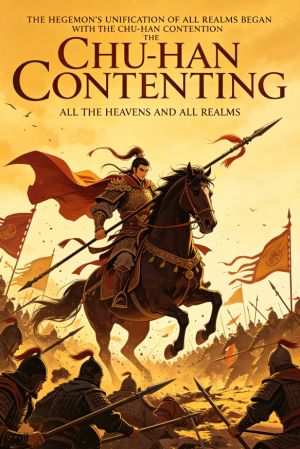
- Book content
- Chapter list
Chapter 1 A Great Injustice Throughout the Ages! On Xiang Yu's Ten Major Crimes
Xiang Yu's injustice is legendary! Based on my research, the so-called "Ten Crimes of Xiang Yu" were most likely fabricated by Liu Bang to demonstrate the righteousness of his rebellion. My analysis is as follows:
For example, one of his crimes was that Liu Bang said Xiang Yu broke his promise and did not make him the King of Guanzhong, but instead made him the King of Han.
In reality, Xiang Yu was completely unaware of this agreement before Liu Bang entered Guanzhong. Otherwise, Xiang Yu would not have refrained from marching for several months after incorporating Zhang Han, showing no urgency in entering Guanzhong.
The third charge Liu Bang leveled against Xiang Yu also proves this point. The third charge was that after rescuing Zhao, Xiang Yu should have led his army back to Chu to report to King Huai of Chu, instead of leading the various feudal lords into Guanzhong.
But aren't charges one and three contradictory? Given the agreement with the King of Guanzhong, why did Xiang Yu turn back to Chu? Why didn't Liu Bang turn back?
If King Huai of Chu's order to Xiang Yu was to rescue the State of Zhao, but his mission to Liu Bang was to enter Guanzhong, then what fairness could there be in this Guanzhong King's Agreement?
His second crime was killing Song Yi's self-respect, which was even more ridiculous. Song Yi was afraid of battle and did not advance, so he should have been killed. The leader of the anti-Qin movement in Chu was Xiang Liang, and King Huai of Chu was just a figurehead. Why couldn't Xiang Yu, who was a brilliant strategist, regain control of the Chu army?
Fourthly, Xiang Yu burned down the Qin Palace and dug up the First Emperor's tomb. The fire raged for three months without going out, something that could only be accomplished by burning an oil field, yet the First Emperor's tomb is still intact.
His fifth crime was the forced killing of Prince Ziying of Qin. But why couldn't he kill the ruler of an enemy state? So many people from the six states, so many members of the Xiang family died at the hands of the Qin people. Wouldn't it be right to seek revenge on the biggest enemy?
His sixth crime was to swindle 200,000 Qin soldiers in Xin'an. This statement was first made by Han Xin, who had already betrayed Xiang Yu at the time. He deliberately praised and framed Liu Bang in order to curry favor with him, so it should not be taken seriously.
There are too many unreasonable aspects to this. Even slaughtering 200,000 pigs wouldn't be that easy, let alone humans.
Historical records regarding the size of Xiang Yu's and Zhang Han's armies also prove this point. How could Zhang Han and the other two rule the Three Qin regions without troops? How could Xiang Yu intimidate the various feudal lords without troops?
Furthermore, Zhang Han's 200,000-strong army was primarily composed of prisoners from Mount Li, with a large proportion of them being from the six former states. They could easily be absorbed into his own army. Xiang Yu even spared Zhang Han, his enemy who killed Xiang Liang; there was no need for him to kill surrendered soldiers. At most, a portion of the surrendered Qin soldiers would rebel, which Xiang Yu would then suppress. Was it really necessary to kill surrendered soldiers who rebelled? Were they to be spared so they could later have a chance to kill the Chu army?
Crimes seven through ten all refer to the same thing: Xiang Yu drove Emperor Yi, Mi Xin, away and then killed him. While it's possible Mi Xin was driven away, it's also possible he didn't want to live in such oppression and wanted to leave on his own.
As for the killing of Emperor Yi, historical records clearly state that it was Ying Bu who killed Emperor Yi. On the surface, Ying Bu was the King of Jiujiang appointed by Xiang Yu and was also one of Xiang Yu's subordinates.
In reality, after Ying Bu was made a king, apart from killing Emperor Yi, he did not "help" Xiang Yu in any other way. On the contrary, after Liu Bang raised the banner of rebellion, Ying Bu immediately betrayed Xiang Yu and followed Liu Bang. Until Liu Bang ordered Ying Bu to eat Peng Yue's flesh, Ying Bu was loyal to Liu Bang.
It's hard to say exactly who ordered Ying Bu to kill Emperor Yi. Perhaps there were many people in the world who wanted Emperor Yi dead, so much so that even after Emperor Yi fled to a place more than 2,000 li away from Pengcheng, he still couldn't escape his clutches.
In my opinion, if Mi Xin hadn't left Pengcheng and had stayed in her position as a banner leader, she might have lived to old age. Xiang Yu was young enough to wait, but most people couldn't.
Killing Emperor Yi and framing Xiang Yu was truly a brilliant move. As for the truth, who cared at the time?
The so-called ten crimes that Liu Bang accused Xiang Yu of were nothing more than a fig leaf that everyone knew about. What's laughable is that even today, people still believe such a flawed frame-up.
...
If you still have questions about Hao Jiu's characterization of Xiang Yu after reading this article, you might want to check out another article in the table of contents, "Reading the History of Chu and Han Using Logical Dialectical Analysis." If you still have questions, you can read the articles published in the "Related to Works" section of my old book, where all the questions about Xiang Yu are answered in detail.
There are always trolls or sycophants who don't read the book who come to the circle to question Xiang Yu. To be honest, I'm tired of replying to them and I feel helpless. Some people just can't stand to see Xiang Yu doing well; it's purely out of jealousy and hatred.
The following explains the character design of Xiang Yu in this book:
Great benevolence and righteousness—
At the Feast at Hongmen, Xiang Yu had the opportunity to kill Liu Ji, but he didn't. Part of the reason was that he regarded Liu Ji as a brother, but the main reason was that Xiang Yu wanted to destroy the tyrannical Qin and bring peace to the world. The tyrannical Qin had been destroyed, and it was time for the people to recuperate. Therefore, he was willing to take some risks and not declare himself emperor, rather than cause more trouble. The purpose of dividing the world into fiefdoms was to quickly quell the war. What the people needed most was a ceasefire. This was true benevolence and righteousness.
Liu Ji, driven by selfish desires, reignited the war, causing immense suffering to the people. Tragedy even erupted in Liu Ji's territory, with people resorting to cannibalism. While Xiang Yu's own army frequently went hungry, the people of Chu fared much better.
Xiang Yu employed elite troops, allowing the people to recuperate and rebuild their lives. Liu Ji, on the other hand, had almost wiped out all the able-bodied men and still failed to defeat Xiang Yu, so he had to send the elderly and weak from Guanzhong to fight.
Coincidentally, after the elderly and weak people of Guanzhong joined the battle, Xiang Yu was defeated. One can imagine the scene of Liu Ji's army driving away the elderly and weak people of Guanzhong and forcing Xiang Yu to retreat.
Iron Will and Tender Heart
I don't need to elaborate on the relationship between Xiang Yu and Yu Ji, right? The Overlord actually had a soft heart. He was not only loyal to Yu Ji in his affections, but he also shed tears for warhorses and wounded soldiers. Some people even interpreted this as womanly compassion. But would a womanly compassionate person do something like slaughtering innocent civilians?
Courageous and resourceful, possessing both wisdom and bravery.
The battles of Julu and Pengcheng perfectly illustrate Xiang Yu's courage and strategy. He possessed not only bravery and martial prowess but also strategic acumen. Could a mere brute have won consecutive victories? Could someone without wisdom have written a treatise on military strategy? Could he have become the overlord who divided the land among the feudal lords? Liu Ji went to great lengths to unite the feudal lords, resorting to spies, traitors, and frame-ups to defeat Xiang Yu. It's not an exaggeration to say that Xiang Yu was courageous, resourceful, and brave.
Unyielding to the death, a hero of unparalleled stature—
Refusing to cross the Yangtze River to the east, he committed suicide. Isn't this the act of a hero who would rather die than submit? If it were Liu Ji, he would definitely have been kneeling and begging for mercy again. He won the world but lost his integrity. Xiang Yu didn't care!
The death of Xiang Yu ended the Chu-Han Contention, which had lasted for several years. This allowed the people, who should have been recuperating after the fall of Qin, to finally breathe a sigh of relief, and also spared Jiangdong from the ravages of war.
Isn't that enough to make him a hero?
In short, while I wouldn't say my premise is flawless, it does make some sense, and it's not just something I made up.
If Xiang Yu were truly as cruel, ruthless, cunning, and treacherous as recorded in Han Dynasty historical texts, many of his choices would have been different. It's too easy to smear the loser; it's three parts truth and seven parts falsehood. Without carefully examining the original historical records, one cannot obtain the true answer.
In order to consolidate its rule, the Han Dynasty had to brainwash the people and officials. If Liu Ji's empire was obtained by betraying Xiang Yu and rebelling, why should he demand that others not rebel?
Therefore, proving that Liu Ji's rebellion against Xiang Yu was correct and deserved is the greatest function of history books. Thus, apart from the three parts of bravery that are true, the remaining seven parts of the records about Xiang Yu are all negative accounts of Xiang Yu losing the hearts of the people and the morale of the army, being cruel and inhumane, etc.
But a fake is a fake. When you cross-reference them, there will always be oversights and inconsistencies. If you're interested, you can read the next article in the section related to the work.
Chapter 2 uses logical dialectical analysis to read the history of Chu and Han.
Those who are interested can take a look; those who are not can skip it.
(I) On the book "Records of the Grand Historian"
History is written by the victors, and this is especially true when the dynasty established by the victors lasts for hundreds of years.
No victor would deliberately smear themselves in history books. They would either be fair and strictly
……