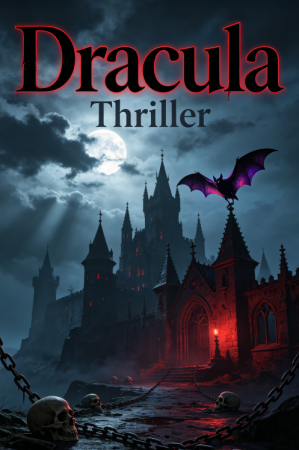
Dracula
Author:Anonymous
Categories:Mystery and Supernatural
Dracula Eastern Europe, 1462 Ever since her prince went off to war on horseback, Princess Elizabeth had been tormented by bloody and terrifying nightmares every night. Each night, the princess would try her best to stay awake; however, once she could no longer stay awake and closed her ey
Dracula - Chapter 1
Dracula
Eastern Europe, 1462
Ever since her prince went off to war on horseback, Princess Elizabeth had been tormented by bloody and terrifying nightmares every night. Each night, the princess would try her best to stay awake; however, once she could no longer stay awake and closed her eyes to sleep, she would soon find herself wandering in nightmares filled with corpses and severed limbs. She would try her best not to look at the faces of the wounded soldiers—yet once again, she was forced to see one of them.
It was always his scarred prisoner's face, and then Elizabeth woke up screaming.
Tonight, as dawn breaks, Elizabeth is in her most desperate moment, pacing back and forth in her attic room on the safest side of the castle. The maids, exhausted from tending to their nearly mad mistress, are asleep. Elizabeth thinks of the thick, bright red liquid flowing from her husband's veins; drop after drop of purplish-red blood, squeezed out with cruel tools by the unseen Turkish jailers.
That endless night, the wind swirled ceaselessly through the battlements, pouring in through the windows that opened to the night, emitting deathly, ghostly groans. She couldn't bear, and had fled, the illusion of the prince's agonizing death. Though she kept telling herself that her fear was unfounded, that she had no idea whether her husband had become a prisoner of the Turks, that there was no concrete evidence that he had been imprisoned or killed, or even merely wounded, it was all in vain.
The only thing this woman knew for certain was that the world was full of death and terror, and that as a soldier's wife, her only fate was to mourn.
At this moment, in a state of fear and exhaustion, Elizabeth was only vaguely aware of her surroundings. She wandered into a room with a flickering fire. Here, the embers of the small fireplace still burned, and a candle on the central table pushed the pre-dawn darkness out the window. The dim light from the fireplace and candle illuminated the colors of the tapestry on the walls and also lit the silk curtains of the bed where she would become his bride.
On that bed, he had held her tightly to his chest, promising her he would return. Here, her noble prince had united with her with such profound love that she understood that if he died, the light of her own life would be extinguished like a small candle.
As the princess stood there trembling in deep thought, an arrow, as light and graceful as a weary bird, flew past the top-floor window, drawing a high arc—clearly the work of a fine bow and a strong archer. The dark-haired Elizabeth didn't recognize it as merely a messenger arrow; she seemed to see a feathered flying demon and retreated, letting out a desperate scream of self-awareness at her lost soul.
The barbed arrow weakly bit into the lone candle, knocking the candle and the golden candlestick to the sturdy wooden table, extinguishing the last spark.
Elizabeth remained terrified and retreating, her classically beautiful face frozen like a statue, her dark eyes fixed on her doom. The embers in the fireplace, along with the waning full moon outside the west window, made it clear to her that the messenger of misfortune had come in the shape of an arrow, with a piece of white paper tightly wrapped around it.
Elizabeth immediately greeted the devilish visitor, unfolding the small piece of white paper and gazing at the message on it. The Latin she had learned as a girl returned—yet before she even read the murderous words, she already knew it was news of his death—and therefore, hers.
In her utter madness and despair, she moved calmly, quickly relit the candle, found a blank sheet of paper, and wrote down what she had to write.
A moment later, she ran frantically, reaching the highest point of the battlements before the first rays of dawn appeared. Under the gradually coloring sky, the morning breeze ruffled her black hair. In the distance, the river encircling the castle lay quietly on the hill, still shrouded in night.
Princess Elizabeth screamed her lover's name and ran swiftly, yearning to plunge into the darkness below to be with him. The battlements flew past beneath her feet, and her feet were in mid-air.
On the same day, a few hours later, after successfully repelling the Turkish invasion, the prince himself led a portion of his army back to his castle.
Following him was a small group of weary and exhausted infantry. This group marched forward, undeterred by the long journey, leaving behind months of fighting. Their steps were swift, for after enduring so much bloodshed and terror, after suffering countless casualties, these men were finally going home. They left behind their fear, their mutual slaughter, and the battlefield strewn with corpses.
This road, far from human habitation, is merely a narrow mountain path winding its way from the east, carrying this group of travelers. Now, they squint at the afternoon sun as they ascend the towering Capasian Mountains. As in every spring, in this country, their homeland, apple, plum, pear, and cherry blossoms bloom everywhere, exuding a captivating fragrance. The mountain path is flanked by verdant slopes, covered with forests of all sizes. Occasionally, clusters of trees and farmhouses stand atop the steep hills.
This group of battle-hardened soldiers mostly carried spears, some armed with longswords or other weapons. Only a few rode horses, and the most conspicuous among them was their commander. He, the prince, was as battle-hardened as his soldiers, but his red armor made him stand out. His once-bright new clothes were now worn and filthy from battle, and a distinctive helmet hung from his saddle. In addition to the longsword at his waist, he also carried a spear. His shield hung on the other side, bearing the emblem of the Dragon Knights.
That afternoon, the months of longing, doubt, and danger finally passed, for he was almost home. He encouraged his black warhorse, urging it to climb a rugged mountain path toward the grey castle that stretched out in the distance against the backdrop of the sky.
About a quarter mile from the castle, the prince paused, his facial muscles relaxing; as if life and hope had dared to show themselves for the first time in months.
“Elizabeth,” he murmured, like a thirsty man uttering the word “water.” The prince urged his weary steed on again, past the small troop of stumbling infantry, each face bathed in the afternoon sun, radiating perfect peace.
However, after the prince had traveled the remaining half of the journey, he reined in his horse again. Unfamiliar black flags fluttered on the castle walls, and the evening breeze carried the sound of monks' funeral prayers. For a long while, as sometimes does in war, the prince felt his heart suddenly stop beating.
But he urged his horse on again—this time quite forcefully—and galloped through the outer gate, through the dark tunnel built of ancient megaliths, and stopped in the inner courtyard, where he immediately dismounted. His face was pale.
Many people had gathered in the courtyard: servants, relatives, neighbors, old friends, and comrades-in-arms—but the lord, who had just returned, had no time to exchange pleasantries with them.
Before the prince sped back, everyone's attention was focused on the dark entrance to the chapel and the actions inside.
The mournful chanting came from the dark doorway.
The prince, tall and lean, strode into the dark entrance. Hundreds of candles burned inside, most around the high altar at the far end of the chapel, seemingly deepening the darkness at the other end. Like the courtyard, it was crowded with people. But the prince's eyes were fixed on only one face, one person. His entire attention was focused on the lithe, pale, lifeless form of a young woman.
She lay at the bottom of the steps at the far end of the chapel, above a massive dragon-shaped stone archway facing the altar, on which hung a large wooden cross and many candles. Her hair was jet black, and her face was as beautiful as it had been in life.
The prince let out a roar like a wild beast, filled with fear and pain, and rushed forward to his knees. He stopped in front of the corpse and helplessly stretched out his arms.
The dead woman lying before him was still wearing her beautiful clothes; strangely, her clothes were soaked with water, so they were wrinkled and folded, clinging tightly to her lifeless body.
But what seeped into the clothes and soaked the steps and stone slabs where the corpse lay was not just water. The body, hidden by the clothes and not showing any cracks or shattering, was still bleeding profusely.
In the silence that followed that terrible shout, the monk in his ceremonial robes took a long step forward.
He cleared his throat and spoke respectfully yet firmly: "Prince Dracula—"
But the soldier had no time to spare. He knelt down, fell forward, and prostrated himself on the woman's corpse, groaning as he kissed and stroked it, vainly hoping it would come back to life.
After a long while, the prince's shoulders gradually stopped trembling with sobbing and became as still as a corpse.
A profound silence enveloped the chapel; the monks' chanting had ceased long ago.
Finally, the prince stood up painfully, his sharp blue eyes sweeping over the half-circle of people standing at the bottom of the stone steps.
"How did she die?" His voice was low and hollow.
Silence remained. No one was willing to answer the question, or perhaps no one dared to answer it.
The prince's expression began to change, a hint of uncertain suspicion appearing amidst his grief, foreshadowing a terrifying rage. He stared at the chief monk who had spoken earlier.
"Qusa, how did she die?"
The head monk, dressed in a formal robe, cleared his throat again.
“She… fell, Your Highness. She fell from the battlements onto the rocks… and then into the river.”
"Fell? Fell? How could that be? How could my wife have fallen?"
Silence fell once more. No one could come up with an explanation—perhaps no one dared to speak up.
Finally, it was the senior monk who revealed the unfortunate truth. “My child—ever since you went to war, Princess Elizabeth has worried about your life every day. She knows the Turks have offered a hefty reward for your head. Just a few hours this morning—an arrow flew into her window, with a note attached. Now we know it must have been a Turkish trick—the note said you had been killed. We couldn't stop her…her dying words…” Father Qusa seemed unable to continue.
"Her dying words," Dracula whispered, standing motionless. "Tell me!"
She left a note that read, 'My prince is dead. Without him, everything is meaningless. May God allow us to meet again in heaven.'
"God? God!" It was a roar of challenge, thrown against the ceiling of the chapel. Those who had been slowly approaching the prince in a semi-circle immediately retreated, as if afraid that a sudden lightning bolt would strike him down.
But Dracula seemed to have forgotten God for a moment. His pained gaze fell once more on the dead Elizabeth, noticing her strange appearance.
"Why is she like this? She's soaking wet, covered in blood... Why didn't her maids wash her and help her change her clothes?"
The chapel was once again shrouded in a deep silence, and a tense atmosphere pervaded the air.
Qusa inevitably took on the burden of explanation once again.
“Child, her maids are very loyal and all hope that she will soon rest in peace in this little chapel. Before—” Qusa stopped, seemingly afraid, or perhaps unsure how to continue.
"How was it before?"
There was no answer. Qusa was pale.
"Go to hell, Father, tell me now!"
Father Qusa reluctantly interjected, “Child, she committed suicide. Those who commit suicide cannot be buried in the Holy Land. The maids wish to hold a secret funeral, with me or any other representative of the Church—”
"The church won't allow her to be buried?"
“Prince, that’s not up to me!” the priest stammered in alarm. “Her soul cannot be saved. She is cursed. It is the law of God…”
Prince Dracula let out another meaningless roar, a deadly rage mixed with the howl of a dying beast. He bent his massive body, grabbed the huge stone basin of holy water beside the steps, and violently overturned it. Clean holy water gushed out, flowing over small puddles and pools on the ground, stained red with Elizabeth's blood, and continued to flow across the floor, splashing onto the sandal-clad feet of the hastily retreating monks.
But they could not leave peacefully, for the enraged lord of the castle would not let them go.
"You speak of God's laws? Is this my reward for protecting the Holy Church? For slaughtering tens of thousands of the ancestors' enemies for me? Then let God's laws go to hell!"
A collective gasp of panic rose from the onlookers. Father Qusa staggered backward, uttering incoherent groans of fear; he feared not so much the prince before him as the prince's blasphemous words and actions. With trembling hands, he raised a small wooden cross as if confronting Satan.
The prince reached out and grabbed the wrist that seemed to threaten him with the cross.
“Blasphemy!” Qusa screamed. “Don’t turn away from God! Don’t—” His words melted into painful cries, for his arm was about to be broken.
Dracula's voice was loud and clear: "I forsake God—and you hypocrites who live off Him. If my beloved must burn in hell—then so must I!"
In the next instant, Father Qusa’s arm bone snapped with a loud crack under the force of the twisting. He immediately fell to his knees, letting out a painful scream, and the small crucifix in his hand fell onto the water-stained floor.
Dracula seemed to have forgotten him, and roared, "Since God will not redeem her for revenge, I will surrender myself to the forces of darkness!" He stretched out his arms, his voice booming, "Let death be my life!"
The monks watching let out another groan of fear. The chapel fell into a state of high alert as the monks scrambled out the doors.
Dracula drew his sword and turned to charge at the large wooden cross atop the altar. In his rage, he thrust the sword with all his might into the very center of the cross. The cross trembled from the sharp impact; if anyone had been nailed to the cross, the sword would have pierced right near the heart.
First there was a sound, then another, and then yet another, screaming as blood seeped from the wound on the cross.
The chapel was now filled with screams. In the chaos of people scrambling to escape, candles and statues were knocked over one after another, and some people even stepped on the body of the dead in the confusion. Afterwards, many people said they saw Christ's blood flowing onto the floor and mixing with her blood.
Driven mad by grief and anger, the prince rushed through the temple and toward the chapel where the Holy Sacrament was kept. He grabbed the golden chalice and carelessly spilled the holy liquid within.
Then he rushed back to Elizabeth's side, bent down and scooped half a cup of blood from the deepest pool of holy blood with the Holy Grail, and then raised the cup high.
“‘Blood is life!’” he quoted from the Bible, then added, “It is also mine!”
Prince Dracula drank it all in one gulp.
After drinking the liquid, he was on the verge of death.
His death throes continued endlessly, relentlessly.
Chapter 1
More than four hundred years later, on another sunny spring day, over a thousand miles from Dracula's Castle, Mina Murray, just twenty years old, had arrived at Shireing Manor on the outskirts of London for an extended interview. Only a few hours had passed since the last servant had settled her in and closed the door to her room.
A gentle May breeze, carrying the rich scent of flowers, drifted through Mina's open window, ruffling her dark hair. She sat thoughtfully at the table. Her room was quite spacious, befitting the grand mansion, and decorated rather lively. The tranquility had been broken a few minutes earlier by the rapid thumping of an old typewriter; the typist might not have been a professional, but their fingers were brimming with energy.
May 9, 1897. I arrive today and will be spending several weeks with Lucy. Life as an assistant governess is rather tedious, and I've long wanted to be with my friend. We can have long talks and build castles in the air together.
Mina paused to think for a moment, then continued typing: "Ever since I began teaching Lucy at Mrs. Wechsler's school, we've shared our secrets with each other. Now we dream of marrying at the same time."
Of course, I will definitely be of help to Jonathan after we get married, especially if my shorthand is good enough to write down everything he wants to say and then type it out for him. So I am practicing typing diligently.
After writing those two paragraphs without hesitation, Mina's fingers paused. A slight furrow appeared on her smooth forehead, disturbing the classical beauty of her face.
“But,” she murmured to herself, “I should be more realistic, more practical—yes, if I’m to be a good wife to a solicitor, I have to be more practical. If I’m typing what other people say instead of what I say myself.”
She thought for a moment, looking around for suitable writing or printed materials, frowning and biting her lower lip. Then, with a hurried and slightly guilty look around the room, making sure no one else was around, she opened the desk drawer and took out a book, a leather-bound copy of Sir Richard Burton's "One Thousand and One Nights".
What makes this book special is that it contains many pages of illustrations that are not suitable for public reading and circulation; the illustration on the page that the book was just turned to caught Mina's eye, making her temporarily put aside her typing practice.
Her dark eyes widened, then narrowed again. A minute later, still holding the book in her hand, engrossed in reading, she heard a familiar voice calling her name from behind.
Mina turned around, startled and confused, instinctively covering the book on her lap with her skirt. Then she relaxed a little. "Lucy, you startled me!"
Lucy Wertner, red-haired, charming, and lively, was only a few months younger than her friends and guests. She strode into the living room and, upon seeing the typewriter, feigned alarm by raising her hands.
“Mina, really! Was it your ambitious Jonathan Hack who forced you to waste a beautiful spring on that ridiculous machine instead of… no…”
Her imagination waned for a moment, but then a mischievous humor returned: "...if possible, perhaps he would even force you to perform some indescribable passionate act on the living room floor."
“Lucy!” Mina was genuinely upset, but only for a moment. “You shouldn’t have said that about my fiancé!”
"Oh, shouldn't we?"
“No! Marriage is not just about physical pleasure—that’s all.” As Mina turned to gesture, the book she had hidden on her lap slipped to the floor.