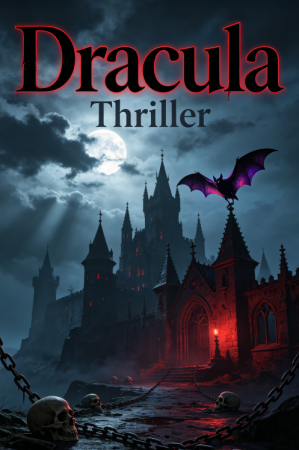
Dracula Eastern Europe, 1462 Ever since her prince went off to war on horseback, Princess Elizabeth had been tormented by bloody and terrifying nightmares every night. Each night, the princess would try her best to stay awake; however, once she could no longer stay awake and closed her ey
- Book content
- Chapter list
Chapter 1
Dracula
Eastern Europe, 1462
Ever since her prince went off to war on horseback, Princess Elizabeth had been tormented by bloody and terrifying nightmares every night. Each night, the princess would try her best to stay awake; however, once she could no longer stay awake and closed her eyes to sleep, she would soon find herself wandering in nightmares filled with corpses and severed limbs. She would try her best not to look at the faces of the wounded soldiers—yet once again, she was forced to see one of them.
It was always his scarred prisoner's face, and then Elizabeth woke up screaming.
Tonight, as dawn breaks, Elizabeth is in her most desperate moment, pacing back and forth in her attic room on the safest side of the castle. The maids, exhausted from tending to their nearly mad mistress, are asleep. Elizabeth thinks of the thick, bright red liquid flowing from her husband's veins; drop after drop of purplish-red blood, squeezed out with cruel tools by the unseen Turkish jailers.
That endless night, the wind swirled ceaselessly through the battlements, pouring in through the windows that opened to the night, emitting deathly, ghostly groans. She couldn't bear, and had fled, the illusion of the prince's agonizing death. Though she kept telling herself that her fear was unfounded, that she had no idea whether her husband had become a prisoner of the Turks, that there was no concrete evidence that he had been imprisoned or killed, or even merely wounded, it was all in vain.
The only thing this woman knew for certain was that the world was full of death and terror, and that as a soldier's wife, her only fate was to mourn.
At this moment, in a state of fear and exhaustion, Elizabeth was only vaguely aware of her surroundings. She wandered into a room with a flickering fire. Here, the embers of the small fireplace still burned, and a candle on the central table pushed the pre-dawn darkness out the window. The dim light from the fireplace and candle illuminated the colors of the tapestry on the walls and also lit the silk curtains of the bed where she would become his bride.
On that bed, he had held her tightly to his chest, promising her he would return. Here, her noble prince had united with her with such profound love that she understood that if he died, the light of her own life would be extinguished like a small candle.
As the princess stood there trembling in deep thought, an arrow, as light and graceful as a weary bird, flew past the top-floor window, drawing a high arc—clearly the work of a fine bow and a strong archer. The dark-haired Elizabeth didn't recognize it as merely a messenger arrow; she seemed to see a feathered flying demon and retreated, letting out a desperate scream of self-awareness at her lost soul.
The barbed arrow weakly bit into the lone candle, knocking the candle and the golden candlestick to the sturdy wooden table, extinguishing the last spark.
Elizabeth remained terrified and retreating, her classically beautiful face frozen like a statue, her dark eyes fixed on her doom. The embers in the fireplace, along with the waning full moon outside the west window, made it clear to her that the messenger of misfortune had come in the shape of an arrow, with a piece of white paper tightly wrapped around it.
Elizabeth immediately greeted the devilish visitor, unfolding the small piece of white paper and gazing at the message on it. The Latin she had learned as a girl returned—yet before she even read the murderous words, she already knew it was news of his death—and therefore, hers.
In her utter madness and despair, she moved calmly, quickly relit the candle, found a blank sheet of paper, and wrote down what she had to write.
A moment later, she ran frantically, reaching the highest point of the battlements before the first rays of dawn appeared. Under the gradually coloring sky, the morning breeze ruffled her black hair. In the distance, the river encircling the castle lay quietly on the hill, still shrouded in night.
Princess Elizabeth screamed her lover's name and ran swiftly, yearning to plunge into the darkness below to be with him. The battlements flew past beneath her feet, and her feet were in mid-air.
On the same day, a few hours later, after successfully repelling the Turkish invasion, the prince himself led a portion of his army back to his castle.
Following him was a small group of weary and exhausted infantry. This group marched forward, undeterred by the long journey, leaving behind months of fighting. Their steps were swift, for after enduring so much bloodshed and terror, after suffering countless casualties, these men were finally going home. They left behind their fear, their mutual slaughter, and the battlefield strewn with corpses.
This road, far from human habitation, is merely a narrow mountain path winding its way from the east, carrying this group of travelers. Now, they squint at the afternoon sun as they ascend the towering Capasian Mountains. As in every spring, in this country, their homeland, apple, plum, pear, and cherry blossoms bloom everywhere, exuding a captivating fragrance. The mountain path is flanked by verdant slopes, covered with forests of all sizes. Occasionally, clusters of trees and farmhouses stand atop the steep hills.
This group of battle-hardened soldiers mostly carried spears, some armed with longswords or other weapons. Only a few rode horses, and the most conspicuous among them was their commander. He, the prince, was as battle-hardened as his soldiers, but his red armor made him stand out. His once-bright new clothes were now worn and filthy from battle, and a distinctive helmet hung from his saddle. In addition to the longsword at his waist, he also carried a spear. His shield hung on the other side, bearing the emblem of the Dragon Knights.
That afternoon, the months of longing, doubt, and danger finally passed, for he was almost home. He encouraged his black warhorse, urging it to climb a rugged mountain path toward the grey castle that stretched out in the distance against the backdrop of the sky.
About a quarter mile from the castle, the prince paused, his facial muscles relaxing; as if life and hope had dared to show themselves for the first time in months.
“Elizabeth,” he murmured, like a thirsty man uttering the word “water.” The prince urged his weary steed on again, past the small troop of stumbling infantry, each face bathed in the afternoon sun, radiating perfect peace.
However, after the prince had traveled the remaining half of the journey, he reined in his horse again. Unfamiliar black flags fluttered on the castle walls, and the evening breeze carried the sound of monks' funeral prayers. For a long while, as sometimes does in war, the prince felt his heart suddenly stop beating.
But he urged his horse on again—this time quite forcefully—and galloped through the outer gate, through the dark tunnel built of ancient megaliths, and stopped in the inner courtyard, where he immediately dismounted. His face was pale.
Many people had gathered in the courtyard: servants, relatives, neighbors, old friends, and comrades-in-arms—but the lord, who had just returned, had no time to exchange pleasantries with them.
Before the prince sped back, everyone's attention was focused on the dark entrance to the chapel and the actions inside.
The mournful chanting came from the dark doorway.
The prince, tall and lean, strode into the dark entrance. Hundreds of candles burned inside, most around the high altar at the far end of the chapel, seemingly deepening the darkness at the other end. Like the courtyard, it was crowded with people. But the prince's eyes were fixed on only one face, one person. His entire attention was focused on the lithe, pale, lifeless form of a young woman.
She lay at the bottom of the steps at the far end of the chapel, above a massive dragon-shaped stone archway facing the altar, on which hung a large wooden cross and many candles. Her hair was jet black, and her face was as beautiful as it had been in life.
The prince let out a roar like a wild beast, filled with fear and pain, and rushed forward to his knees. He stopped in front of the corpse and helplessly stretched out his arms.
The dead woman lying before him was still wearing her beautiful clothes; strangely, her clothes were soaked with water, so they were wrinkled and folded, clinging tightly to her lifeless body.
But what seeped into the clothes and soaked the steps and stone slabs where the corpse lay was not just water. The body, hidden by the clothes and not showing any cracks or shattering, was still bleeding profusely.
In the silence that followed that terrible shout, the monk in his ceremonial robes took a long step forward.
He cleared his throat and spoke respectfully yet firmly: "Prince Dracula—"
But the soldier had no time to spare. He knelt down, fell forward, and prostrated himself on the woman's corpse, groaning as he kissed and stroked it, vainly hoping it would come back to life.
After a long while, the prince's shoulders gradually stopped trembling with sobbing and became as still as a corpse.
A profound silence enveloped the chapel; the monks' chanting had ceased long ago.
Finally, the prince stood up painfully, his sharp blue eyes sweeping over the half-circle of people standing at the bottom of the stone steps.
"How did she die?" His voice was low and hollow.
Silence remained. No one was willing to answ
……