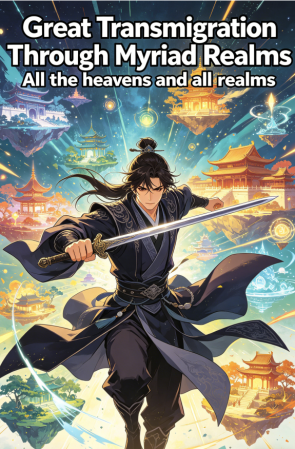
Great Transmigration Through Myriad Realms
Author:Anonymous
Categories:other
Chapter One: Traveling Through Time and Space, Gathering Qi at Dawn In the vast void, a middle-aged Taoist priest dressed in feathered robes and a star-studded crown stood with his hands behind his back. Against the backdrop of the vast void, the countless stars are reduced to mere spec
Great Transmigration Through Myriad Realms - Chapter 1
set up
In the beginning of the universe and time, there was a point with infinite mass and density, which itself was infinite energy. After the Big Bang, the energy that was originally one dispersed to every corner of the universe. Among them, the forms that absorbed more energy developed will and became "gods".
After God was born, He came to a corner of the universe and began creation in this world called the "Five Continents." The goddess Nüjing created humankind from clay in God's image, and the god of wisdom, Funong, bestowed wisdom upon humankind, giving them knowledge.
The five continents are: Donghai Danzhou, Nanyang Yuanzhou, Xiguang Ezhou, Beiji Hanzhou, and Zhongping Shenzhou. Among them, Donghai Danzhou and Nanyang Yuanzhou are isolated overseas, while Ezhou, Hanzhou, and Shenzhou are connected by isthmuses or high mountains. Each continent has several countries, but due to the high mountains and long distances, many countries have never even heard of each other. The story mainly takes place on Zhongping Shenzhou.
The main intelligent races in the five continents:
Humanoid races:
Humans: The most numerous of all intelligent races, possessing an extremely balanced distribution of the five elements. While lacking any obvious strengths or weaknesses, they have a 25% resistance to all elemental spells and a 25% energy bonus to them. This balance makes them suitable for any profession in the Divine Continent, but becoming a grandmaster requires immense effort and considerable luck. Besides religious beliefs, humans also worship ancestral deities, believing their ancestors' souls are watching over them.
The Yue people, standing only about three-fifths the height of an average person, originally lived in hilly areas. During the "Million Ears" war, they spread to various parts of the world, reportedly found on all continents except Zhongping Shenzhou, where they were called "dwarfs." They are extremely confident and proud of their height, believing that the goddess Nüjing meticulously created the short Yue people first, and later, tired of them, casually molded other human races. Therefore, they possess a talent for creation unmatched by any other race. However, the Yue people split into two groups: one group lives in caves, belonging to the metal element (giving a 50% to 100% bonus to attack and defense), and are excellent forging masters; the other group lives in tree-dwellings, belonging to the wood element (giving a 50% to 100% bonus to attack and defense), and are superb mechanical designers. Although the two groups look down on and distrust each other, they maintain a facade of respect and tolerance. Besides their religious beliefs, they also worship the legendary god of craftsmen, Gongshu Pan.
The Rong people were a nomadic people living on the grasslands. Physically, they were not significantly different from ordinary people, but slightly taller and with darker skin. If it weren't for their fire element (which grants a 50% to 100% bonus to attack and defense), it would be difficult to distinguish them from other humans. The Rong were a nomadic people who lived on horseback, residing in large, easily movable tents. Rong cavalry units were consistently among the most frequently used assault forces in warfare. Historically, the most famous Rong king, Sihai Khan, launched the "Million Ears" expedition, which brought almost half of the Central Plains and Western Guang'e Continent under his rule. Because the enemy's ears were used as a marker of victory during the campaign, this expedition was called the "Million Ears." Besides their religious beliefs, they also worshipped the legendary war god Potian, who is said to have shattered the sky.
The Qiang people are the tallest human group, averaging half again as tall as the average person. They are extremely strong, yet gentle and even somewhat slow-witted. Their elemental attribute is Earth (earth-based attacks and defenses are increased by 50% to 100%). Their strength and loyalty are their most reliable assets. Although somewhat slow in reaction, they are by no means stupid. Because of their size, they often treat other races like children. When they associate with the Yue people, they often become the objects of the Yue's commands, but they don't mind, as helping and caring for others is in their nature. However, due to their powerful offensive and defensive capabilities, especially their astonishing attack power in a berserk state after being strongly stimulated, they often become an indispensable infantry force in wars between various countries. Because of their simplicity, the Qiang people worship the goddess Jing, the mother of all things.
The Yi people: Originally a race inhabiting the seashore, they once vied for dominance over all human races in ancient times. After their defeat, they returned to the coast. Their element is water (water-based attack and defense are increased by 50% to 100%). A saying among them goes, "Every Yi is born in water, grows in water, dies in water, and is buried in water." Their powerful aquatic abilities meant that any navy required Yi members to be considered combat-ready. After the "million ears" incident, some Yi migrated inland but still lived along rivers and lakes. Fishing is their traditional industry, but with frequent exchanges between continents, long-distance maritime trade created internal conflicts. Whether to choose this new and highly profitable trade or the ancient way of life passed down for millennia often became the focus of debate between generations. Interestingly, the Yi often chose a middle path: long-distance maritime trade in their youth and fishing in their later years. In terms of belief, besides religion, they held great reverence for the sea god and the dragon.
Non-human races:
Fairies, also known as monsters, are life forms gradually created over a long period by various sentient beings throughout the five continents, absorbing the energy of the primordial universe. They possess extremely powerful magic and strength. If they weren't almost infertile and could only reproduce naturally, they could easily seize dominance from the human race. In terms of personality, they value independence and therefore maintain a respectful distance from one another, making it difficult for fairies to unite. The vast majority live in treacherous places inaccessible to humans, while a few have transformed into humans and live among them. They can intermarry with humans, and their offspring are not significantly different from ordinary human children, except that they may possess some unique abilities. Generally, they do not intervene in human conflicts unless they believe such conflicts could lead to the loss of control over the entire world. Their five elements attributes are not absolute; they are generally determined by the five elements attributes of the entity that gave birth to them.
Demons: Humans use every terrifying word imaginable to describe them, demonstrating their fear of this powerful race. Not only humans, but even fairies shun demons. Long before the "Million Ears" war, demons vanished from the land of gods, demons, and humans, supposedly eradicated by a combined effort. To combat them, gods, demons, and humans even developed two types of magic beyond the Five Elements—air and lightning. These powerful spells now only exist in demon legends. In ancient tales, the origins of demons are a mystery, with claims that fallen gods or fairies created them, but without concrete evidence. Fairies and gods alike remain tight-lipped about this. Their Five Elements attributes, like their origins, are shrouded in mystery. "Slaughter" and "bloodlust" are the impressions they leave on the world, but in reality, demons are not absolutely evil, just as humans are not absolutely good.
God: The greatest inheritor of the primordial energy of the universe, possessing unimaginable abilities, but rarely interfering in worldly affairs. Apart from being found in the legends of heroes and demons in the mythological era, there is almost no evidence to prove their existence.
The Lineage of the Gods: Legend has it that at the beginning of the universe, the ancient god Prajna was born. He used a giant axe to destroy the initial chaotic state of the universe. However, this explosion also shattered his body into countless pieces. Sixty thousand years later, the goddess Nüjing was born from a part of his body. The goddess came to the earth and, feeling lonely, used clay (also a part of Prajna's body) to create humans. At this time, humans were immortal, just like the gods. Although scholars of various races have endlessly debated which race the goddess originally created, no one denies that the goddess Nüjing is the common mother of all mankind. At this time, other parts of Prajna's body also transformed into gods, including Gongshupan, the god of craftsmen; Potian, the god of war and fire; Gonglong, the god of the ocean and water; and other deities. To vie for the position of chief deity and the right to rule over the new life created by Nüjing, the gods waged war. Humans also intervened in this divine war. To punish humanity for interfering in divine affairs, Potian, in a fit of rage after his defeat, shattered the sky, releasing Youming, the god of death. Humanity was thus condemned to the suffering of birth, aging, sickness, and death. Nüjing, unable to bear seeing her children tormented by the even more powerful gods beyond the heavens, used her own body to block the sky shattered by Potian, transforming into the stars. Moved by this, the gods established the "Law of the Gods," no longer directly interfering in human affairs, allowing humanity to control its own future. As these ancient gods gradually faded from human memory, some humans realized they were also part of Prajna, discovering they possessed immense power. These people became new gods, who, according to their own understanding, imparted the true meaning of Prajna's power to humanity, thus giving rise to numerous faiths among humankind. Relations between different faiths can sometimes be very tense, even leading to wars between different faiths. New gods will also help their believers. This has led to three "wars of the gods" in history. In the end, most of the remaining gods agreed to sign the second "law of the gods", and they no longer directly intervened in human affairs.
Faith: Human beings' magical power comes from their own faith. Any human being in Shenzhou can choose a faith, or they can choose not to have any faith at all. In this respect, Shenzhou is relatively tolerant. Some faiths can even coexist. For example, the three most popular and influential faiths in Shenzhou all have the saying "three religions sharing the same origin".
Confucianism: It is the most influential religion in China, and rulers of various countries and dynasties often adhered to this school of thought. To ordinary people, the doctrines of this school are nothing more than strategies for self-cultivation, family management, governing the country, and bringing peace to the world, as well as shortcuts to fame and fortune. However, for those who truly grasp the essence of this school, it contains incredibly powerful spiritual and mental magic, and once mastered, it is quite convenient to use.
Taoism: This is the religion that most emphasizes the harmony and unity between humanity and heaven and earth, thereby borrowing the power of heaven and earth. They have a deep understanding of the Five Elements magic and possess Five Elements magic with extremely strong offensive capabilities. They can even communicate with ghosts and gods and borrow their power.
Buddhism: This sect emphasizes both physical training and mental cultivation. Masters of this sect are often skilled in hand-to-hand combat or staff fighting, and possess powerful healing and defensive auxiliary spells. Their limb and soul spells are particularly unique.
Other: Because of its inherent tolerance, there are many other faiths in Shenzhou, and some of them have strange abilities. For example, there is the Lingjiao, which can summon and train various low-level fairies or wild beasts in nature, and the Youmingjiao, which worships the spirits of the dead, and the Angjiao, which only worships one god, "Ang".
Volume 1
Prologue: The Spreading Fire
Author: Saint Morning Thunder
In the early winter air, the god of night had already draped his wide black robe over the earth, and a few mischievous stars immediately twinkled in the sky, ignoring the faint yellow glow still clinging to the western mountain peaks. Wisps of smoke rose from chimneys, and mischievous dogs darted from house to house in the mountain village, occasionally startling the roosting chickens into clucking protests. This, in turn, startled the dogs, who barked wildly at what they perceived as intruders.
Unlike other mountain villages where the air at this time is filled with the sounds of children being called back for dinner, in this remote mountain village on the border of the Su Kingdom in the Central Plains, every adult knows exactly where their children will be at this hour. Village head (the respectful title for the head of a village in the Su Kingdom) Li Tan is surely using his wooden ruler to discipline the lazy children and preparing to keep them behind to recite Confucian classics.
Although most villagers do not expect their old hens to hatch golden phoenixes, nor do they believe that Li Tan, the village head who has returned from "wandering" outside, can raise his children to be pillars of society, they really do not have much time to take care of these children, let alone educate them, in addition to their busy farm work. Therefore, for thousands of years, the children here have been born and raised in the mountains, until the current village head Li Tan returned to the village.
Although Li Tan was also from this village, his family was said to be a branch of the royal family of the Su Kingdom, making them relatives of the emperor. They owned dozens of acres of land and had served as the village head for generations. Li Tan's father intended for his only son, Li Tan, to achieve great things outside the village, sending him to study in the city. However, soon after, Li Tan's parents died one after the other from the bite of a poisonous snake. Li Tan returned home to observe three years of mourning before leaving again, only returning two years ago. Villagers who went to the city on business heard that he had served in the army, but because Li Tan himself kept his experiences of those ten-plus years a secret, there was no concrete evidence.
Soldiers were not very popular in the small village. Although war had raged outside for many years, it was almost a different world to this isolated village. The village was so remote that none of the military officers who were conscripting men were willing to come here. So, compared to other places where almost every family had fallen in battle, the people of this village lived in paradise.
While loudly reciting the Confucian classics taught by Li Tan, Li Jun secretly made faces at Shi Quan, who was sitting next to him, making him laugh.
One child started laughing, and soon all the children joined in. Li Tan, who had been listening to the recitation with his eyes closed and head swaying, realized something was wrong. When he opened his eyes, all the children's faces had returned to calm, and more than a dozen pairs of eyes of different sizes were staring at his face, waiting to see how he would handle the situation.
"Who spoke first?"
Li Tan asked naturally, assuming that the laughter was caused by someone telling a joke. But none of the children answered. Ever since they received their Confucian classics education from him, the children had found it a pleasure to oppose him. Although they all liked him, they all disliked his boring lessons.
After surveying the children for a while, Li Tan could only see sly smiles on their tense faces, but nothing else. So he forced an angry expression onto his face and shouted, "Which little brat started talking?"
Li Jun stood up and shouted, "Sir, you were the one who started speaking, you little rascal!"
Li Tan was taken aback, then realized that he was indeed the only one asking who was speaking. He turned his back so the children wouldn't see the smile on his face, and said in an unusually stern voice, "Li Jun, how dare you be so disrespectful to me before the sage's tablet?"
Li Jun stuck out his tongue at the children around him and said, "The sage said that one should speak without reservation. Since I know that it was you, little rascal, who started speaking, that I should answer your questions."
Li Tan was nearly driven mad. He had taught this nine-year-old a few words of wisdom from the sages, only to have the child use them to indirectly insult him. He forced a smile off his face, picked up a wooden ruler from the small table where the sage's tablet was placed, turned around, and shouted, "Li Jun, stretch out your hand!"
The children looked at the ruler in Li Tan's hand with some fear. Li Jun also began to feel a little scared. Just then, a series of discordant footsteps accompanied by the sound of metal clanging came from outside. Li Jun cheered, thinking that his parents had finally come to call him for dinner. If that was the case, he could avoid the beating. So, without waiting for Li Tan to say that he could leave, he rushed out the door.
Just as Li Jun rushed to the door, he saw a figure. He tried to move aside, but it was too late. Just as he was about to bump into someone, a strong hand grabbed his shoulder and pulled him back from the doorway.
Li Jun turned around and saw Li Tan already standing behind him, wearing a fawning smile: "Sir, this is a private school. May I ask what brings you here?"
A group of soldiers arrived, their chaotic attire suggesting they were not regular soldiers, but rather a motley crew, something that had never happened in this small village before.
The soldier who was stopped by Li Tan peeked into the house and saw more than a dozen children of different ages. He couldn't help but laugh: "I didn't expect to find such a remote place with such pedants (a derogatory term for people who study Confucian classics in Shenzhou). You are the village head the villagers were talking about?"
Li Tan performed a Confucian-style cupped-hand salute and said, "I am the village head. May I ask what your orders are, sir?"
The soldier punched Li Tan hard in the stomach. In excruciating pain, Li Tan threw down the wooden ruler, curled up into a ball, and vomited repeatedly. Seeing Li Tan's suffering, the soldier laughed again: "You scumbag, hand over all the treasures and grain in the village, and I'll give you a quick death!"
Li Tan felt a chill run down his spine. Before he could reply, two more men who looked like leaders walked into the courtyard. One of them said, "No need to say more, just kill them all. We'll come looking for them ourselves later."
A man nearby blew a cow horn, and instantly, cries and screams erupted from the small village. The soldiers had subdued every household. In almost an instant, the entire village had become a slaughterhouse.
The children burst into tears, and if they weren't afraid of the soldiers standing at the door, they would have rushed home immediately. Li Tan was both shocked and furious. The soldier who had started hitting him grinned and drew his knife. Li Tan had no choice but to take two steps back to avoid the knife.
The soldier pressed closer, and Li Tan made a hand seal with his left hand. When the soldier met Li Tan's eyes, he felt a piercing light shooting from Li Tan's eyes, making him afraid to look directly at him. Just as he was momentarily stunned, Li Tan snatched the knife from his hand and held it to his neck.
"That sour guy is a Confucian philosopher!" a soldier shouted. "Send archers to shoot him dead!"