The Enigma of the Ancient Mirror The moon had already risen. In an abandoned house on the outskirts of the city, the withered yellow grass on the ground appeared even more gloomy and messy under the waning moonlight. Dead vines climbed haphazardly on the wall beside it, and a gloomy an
- Book content
- Chapter list
Chapter 1
The Enigma of the Ancient Mirror
The moon had already risen. In an abandoned house on the outskirts of the city, the withered yellow grass on the ground appeared even more gloomy and messy under the waning moonlight. Dead vines climbed haphazardly on the wall beside it, and a gloomy and gloomy atmosphere permeated the entire courtyard.
A black figure darted swiftly into the courtyard, like a ghostly apparition that appears after nightfall.
A commotion grew louder as several villagers approached from a distance, hurrying home for dinner. Upon seeing the mansion, which resembled a colossal beast in the dim light, their earlier chatter fell silent instantly, their expressions grave. As they passed the mansion, they kept their eyes closed, heads bowed, holding their breath, and quickly moved away from the suffocatingly dark atmosphere.
The boy at the back of the group seemed to hear a noise as he passed the mansion. He couldn't help but look up and peer into the courtyard...
In the hellish, dimly lit courtyard, a dark shadow suddenly flashed by. The boy, terrified, fell straight forward. As his face slammed onto the ground, his pupils gradually dilated, reflecting a horrifying crimson...
Chapter One: The Ancient Mirror
July in summer should be sunny and bright, but at this time, the sky over Black Town is just as its name suggests: dark and gloomy, with incessant rain.
Heizhen is an ancient town on the southwestern border. Established during the Nanzhao Kingdom, it flourished most during the Ming Dynasty and was a renowned salt-producing area. Due to its remote location, the buildings in Heizhen have largely retained their Ming and Qing Dynasty style. The only bustling area in the entire town is a slightly wider bluestone-paved road. Along both sides of this road, rows of "one-seal" style courtyard houses sit haphazardly. Most of these courtyards were built during the Ming Dynasty and are quite old; their weathered walls still reveal the gray-tiled, white-walled, Jiangnan-style courtyard architecture of that era.
A beautiful, youthful figure flitted back and forth between the ancient city walls, like a beautiful, colorful butterfly dancing among them, adding a vibrant rainbow to the ancient and solemn Black Town, and attracting the admiring glances of many men.
Ningxia, brimming with youthful energy, strolled along the oldest stone-paved road in Heizhen, completely at ease, seemingly unaware of the slight ripples her presence caused, nor feeling the discomfort brought by the rainy weather. She had recently read about this almost forgotten ancient town in the newspaper and immediately became very interested. As soon as the weekend arrived, she couldn't wait to hop on a train alone and come to Heizhen.
The town of Heizhen in the drizzling rain is like a newly completed Chinese ink painting scroll. The ancient city walls, exquisite small buildings, and towering ancient trees all exude a rare old-fashioned charm. Although the colors of the entire town are somber, they also have a moist quality, as if the painter's ink has not yet dried, and the scroll still exudes a lingering fragrance of ink.
In just half a day, Ningxia had explored the entire Black Town, her interest undiminished. Even as evening approached, she braved the drizzling rain, strolling along the town's only cobblestone street, browsing the shops that still retained their ancient charm.
Most of the shops here opened gradually after the 1970s. Many shop owners converted the first-floor hall of their courtyard houses into shops, while the second floor and inner courtyard were divided into residential areas for several families. After the reform and opening up, the shop owners abandoned their traditional trades and displayed various modern daily necessities, appliances, colorful clothes, magazines, etc., which coexisted in a very discordant way with the old style of the shops with carved window lattices.
However, what interested Ningxia was not these trendy goods, but the few shops that still carried on the tradition of selling ancient items. She was surprised to find that things like bronzeware, silverware, leather goods, and fabrics, which were long gone in big cities, were still popular here. Walking among them, one felt as if they had traveled through a fantastical time-travel between ancient and modern times.
At the very top of the bluestone path stood three neatly arranged memorial archways, representative of the town, bestowed by the emperor during the Ming Dynasty to commemorate three virtuous women. Ningxia scoffed at such ancient practices that stifled human freedom, and so she turned and walked into a narrow alleyway between the tiled houses beside the bluestone path.
Ningxia regretted coming to this secluded alley, because this road was just a shortcut for the town's residents to go home. On both sides were ordinary houses with earthen walls and gray tiles, and even the more solemn courtyards that had been next to the bluestone road were rare. It was quiet all around, and a faint, strange atmosphere silently wafted from the depths of the alley. The further she went, the stronger this feeling became.
Guided by this feeling, Ningxia quickly arrived at a barren meadow at the end of the alley. Beyond that lay a vast expanse of lush green woods, which from a distance resembled a thick, dark green wall, shutting out the hustle and bustle of the world at this far end. A shiver ran through her, and Ningxia sneezed, realizing that goosebumps had risen all over her body. Just as she was about to turn back, the light rain intensified, turning the road into a muddy mess.
A small courtyard came into view. It was an extremely inconspicuous little courtyard, with mottled water stains showing on the gray and old walls. But at this moment, the only thing that could shelter Ningxia from the heavy rain was the eaves in front of this courtyard. There was no time to hesitate; the increasingly heavy rain forced her to run towards the eaves.
As soon as she reached the eaves, a torrential downpour began. Ningxia was somewhat annoyed that she had only worn a tourist hat when she went out. She took off the soaking wet hat, shook off the water droplets, and her right hand touched a soft object. She turned around sharply and saw that there was a person standing behind her! She almost screamed. When she ran over here, she hadn't seen anyone there at all. He seemed to have appeared out of nowhere without making a sound.
Once Ningxia calmed down, she realized that the person standing before her was an extremely old man. His exact age was impossible to discern; his hair was completely white, and he wore an old-fashioned black robe. In his right hand, he held a sandalwood cane that gleamed with a purple light. This elderly man, his face covered in deep wrinkles, stared intently at Ningxia with cold, icy eyes. The almost invisible whites of his eyes pierced Ningxia's body like needles, causing her to shudder.
Under the gaze of the dark-skinned old man, Ningxia shivered again, swallowed hard, and stammered in a hoarse voice, "Uncle... old man!"
The old man stared at Ningxia for a moment with his somber, cold eyes before asking, "What do you want to buy?"
Ningxia paused, glanced behind the old man, and suddenly realized that this was actually a small, old shop. This little shop wasn't much different from the shops lining the cobblestone streets of Black Town, but its location in such a remote place was quite puzzling. As she carefully examined the items inside, a chill ran through her again.
The shop in front of me is a two-story "Yikeyin" building, which is much older and more dilapidated than the courtyard houses lining the bluestone-paved road. The vermilion gate, which should have been red, has been blackened by cooking fumes and is unrecognizable. The window frames, which are carved with dragon and phoenix patterns, are also covered with thick layers of grease, and you can still vaguely see the original gilded base color. Only from the tall gate can you still trace the glory of this building many years ago.
Inside the small shop, numerous wreaths of varying colors and all sorts of funerary clothes and implements were displayed, with two dark, gleaming coffins in the corner! What shocked Ningxia most wasn't just the overwhelming array of funerary objects, but the human figure directly in front of her. The room was dimly lit, with only a small door at the back of the hall letting in some light. Although most of the funerary objects were made of brightly colored paper, the entire hall was filled with a somber, deathly atmosphere, sending chills down one's spine.
On the Eight Immortals table in the center of the hall, three sticks of sandalwood incense in an exquisitely crafted bronze incense burner were emitting wisps of smoke, and the light shining through the small door created a very strange scene. The musty smell in the whole hall was mixed with the sandalwood scent, and the aroma was also indescribably strange.
Everything in the room, in Ningxia's eyes, seemed to form a background color, and what this background color highlighted was the most eye-catching painting on the wall—a slender, beautiful woman in ancient costume, standing facing her on a scroll whose paper had turned grayish-yellow! The entire scroll looked quite old, but the woman in the painting suddenly evoked an indescribable sense of awe in Ningxia!
The woman in the painting has a cloud-like hair bun adorned with a five-phoenix hairpin with pearls hanging from it. She wears a bright red satin blouse embroidered with gold and colorful floral and bird patterns on a bright red satin background. Over this, she wears a red vest with silver fur trim. She also wears a red pleated skirt with butterflies embroidered in gold and silver. A long magenta sash is tied around her waist, and next to it hangs a small red sachet, on which a delicate butterfly also flutters.
Judging from her attire, she looks like a woman about to get married, but the red headscarf on her head is missing from the picture, and her beautiful face carries an extremely melancholy and sad coldness.
Due to its age, the original bright red color turned into a dark blood red, and the woman's skin also turned sallow. This gloomy color gave people a strange chill, but the woman's lifelike melancholy expression and cold eyes made it seem as if she lived in a painting, making people feel incredibly real.
"Want some antiques?" the strange old man asked in a hoarse voice.
This sentence made Ningxia stop in her tracks. The reason she liked to visit these old shops was precisely because of her love for antiques.
Turning around, Ningxia felt a chill run down her spine. She felt as if the strange old man before her could read her mind, and her voice trembled slightly: "What...antique?"
The old man's wrinkles twitched, making it impossible to tell whether he was laughing or crying; his expression was extremely grim. He slowly took a square cloth bag from the cabinet next to him where funeral clothes were displayed and placed it on the table.
Upon seeing the cloth bag, a strange feeling arose spontaneously. Curiosity outweighed the initial fear, and Ningxia slowly walked towards the bag. The cloth bag was made of blue tie-dyed homespun cloth, common in the southwest region. The color had turned grayish-white, and it looked quite old. The bag was shrouded in rising blue smoke, and an eerie atmosphere spread from all sides.
Ningxia swallowed hard, lowering her head to avoid looking at the woman in the portrait, feeling her gaze fixed directly on her. She reached out and untied the knot in the cloth bundle. The grey-blue cloth unfurled, revealing a rectangular, purplish-brown wooden box, roughly the size of a dictionary. The box's thickness was equal to its width, and its four sides were carved with scenes of the Queen Mother's birthday banquet. Various deities presented different treasures to the revered Queen Mother. Besides flowing clouds, ancient trees, and various mythical beasts, the entire box was also uniquely carved with an ancient, translucent pattern, the craftsmanship exquisite.
"What is this?" Ningxia asked curiously, looking down at the exquisitely carved patterns on the sandalwood-like box in front of her. She had never seen such patterns before, nor had she ever seen such a box.
"This is the dressing table!" the old man said.
"A cosmetic box?" Ningxia suddenly realized what it looked like. She had learned about such a thing from books; it was a box used by women in ancient times to store cosmetics. Thinking of this, Ningxia unconsciously looked up at the woman in the portrait, whose eyes were also quietly looking down at her.
"This thing belongs to her!" The strange old man revealed Ningxia's thoughts.
"Really?" A chill ran down Ningxia's spine. She had intended to leave as quickly as possible, but the sandalwood box before her was captivating. Her hand unconsciously reached for it, and a strange yet familiar sensation suddenly shot through her like an electric shock, coursing through her bones and reaching her cerebral cortex. In a daze, she saw an anciently patterned butterfly fluttering towards her, but as she tried to catch it, it vanished.
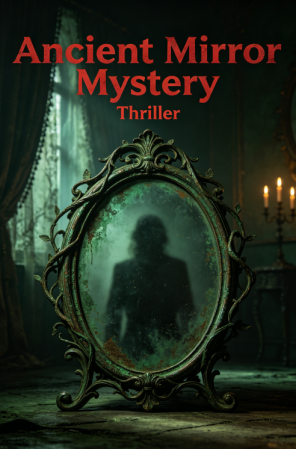
Startled for a moment, Ningxia opened the box. A surprised face suddenly appeared before her eyes. Upon closer inspection, she realized that the seemingly familiar face was actually her own – a bronze mirror had appeared in the box!
Its mirror wasn't a typical circle or oval, but rather a near-circ
……