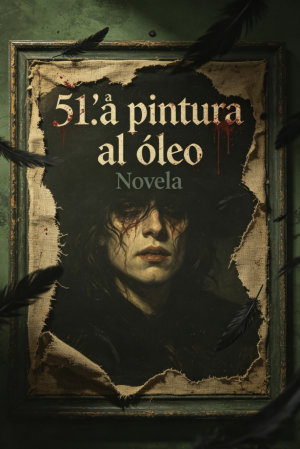
Childhood on the Mountain Top (Part 1) gold Lu Ni curled up in her blanket, her large, dark eyes wide open, the darkness overflowing as if it had soaked into the entire world. In the darkness, sounds like water snakes and vines coiled around her, entwining her somewhat stiff body. In her
- Contenido del libro
- Lista de capítulos
Capítulo 1
Childhood on the Mountain Top (Part 1)
gold
Lu Ni curled up in her blanket, her large, dark eyes wide open, the darkness overflowing as if it had soaked into the entire world. In the darkness, sounds like water snakes and vines coiled around her, entwining her somewhat stiff body. In her eyes, in the darkness, there was a magnificent entanglement and tenderness, a desperate fear and desolation. She seemed to see dusty spiderwebs hanging from the ceiling, swaying eerily amidst the tangling sounds.
The sound came from next door, from the room separated by wooden boards. A woman's voice was hysterical and exhausted, as fragile as a spider web about to break in a storm, yet it was also a desperate, pale insistence on maintaining the last vestiges of her life: Get out!
Then came a series of crashing and banging sounds: the sound of heavy objects falling onto the bed, the sound of tearing, and the sound of slaps across faces, mixed with a man's words as he forcefully shouted: "You bitch! You're my wife!"
All the noise subsided, and the world felt like a desolate, empty garden, offering no solace. Occasionally, there were suppressed sobs and heavy breathing from women, followed by bursts of wolf-like howls, heavy panting from men, and the rhythmic creaking of the wooden bed… Finally, everything fell truly silent, except for the man's loud snoring.
Lu Ni swallowed hard, shifting her stiff body. The adult world was mysterious and somewhat terrifying; she couldn't understand what happened each day, so she could only fall asleep with a few questions in her mind. Her breathing relaxed, and she unconsciously burped, the aroma of boiled sparrows filling the air. She couldn't help but smack her lips in lingering pleasure; even a burp tasted good after eating something delicious. Today, Qiu Ping had caught three sparrows in a brick "trap," and after Qiu Ping's mother cooked them, Lu Ni ate two—it was so satisfying! With a sense of contentment, Lu Ni slowly drifted off to sleep.
In her sleep, she was suddenly pulled into a warm, familiar embrace—it was her mother's. Lu Ni struggled to open her eyes; the dim light in the room suddenly came on, so bright it was hard to open them. A suffocating feeling of being held so tightly filled her senses; there was a tangled mess of black hair on her chest, smelling of sweat and kitchen fumes—she knew it was her mother's head.
Her mother kissed her passionately; only at times like this would her mother hold and kiss her like this. Lu Ni was held in a daze; she was sleepy and scared.
With tears streaming down her face, her mother suddenly turned away from Lu Ni. Lu Ni saw that pale, beautiful face, haggard, with the marks of that man's hand on her face, but it was still a beautiful face.
There was a neurotic arrogance in her mother's eyes, which frightened Lu Ni. Every time she saw that look in her mother's eyes, she would be afraid. Regardless of whether she was afraid or not, her mother just kept shaking Lu Ni's arm and said: You have to go back to Shanghai, you know! You must go back to Shanghai! Live in Shanghai for your mother again! Her mother was not wearing any clothes, and her white breasts were pinched until they were red and white. When she shook Lu Ni, her breasts swayed helplessly and humiliatingly.
Lu Ni looked at her mother blankly. She didn't know where Shanghai was, nor did she understand how she could live her mother's life again. She simply developed a fear of Shanghai. Would Shanghai be as good as this place? Could she go fishing in the river? Could she steal bird eggs from the trees? Could she still play with Qiu Ping? Her large, dark eyes widened in fear as she looked at her mother, who was on the verge of madness. She didn't yet understand how a proud woman's despair for herself and her life, the imbalance between reality and hope, could drive her to such madness.
Childhood on the Mountain Top (Part Two)
gold
Lu Ni was four years old that year, and her parents lived in the next room.
Lu Ni's mother was one of many young people who came to support the border regions during that era. She came from Shanghai, a place that filled her with immense pride. Because of this, she felt secretly proud, but also deeply resentful and bitter. She was from Shanghai, and one day she would return to the glittering city, and then all her suffering would end.
Lu Ni's mother was a Shanghai-style beauty with an innate noble temperament, a tall and slender figure, and a beautiful head held high with a cold arrogance on her long, white swan-like neck. How could a woman with such breathtaking beauty be willing to spend her whole life in this utterly unsophisticated place?
But Lu Ni's mother still married Liu Fulai, a dark-skinned, rough-looking man with yellow teeth, calloused hands, and always black stuff under his fingernails—a warehouse keeper. At that time, she was almost due to give birth to Lu Ni.
Liu Fulai was an outsider who came to this village years ago to escape famine. He was taken in by an elderly, widowed shepherd named Old Man Liu, and after Old Man Liu's death, Liu Fulai inherited this small house. It was a tiny two-room house with mud walls and a thatched roof. If it weren't for Hu Ni's mother's misfortune, Liu Fulai would probably never have been able to find a wife. But who could blame him when such a noble beauty herself was so pathetic, becoming a "loose woman"? Now Liu Fulai could even speak some coarse language in public and private, and he was living like a decent human being.
The house had long since begun to show signs of decay; dark green moss covered the base of the walls, and wide cracks appeared in the walls. Unlike most houses, it didn't have a courtyard; instead, there was a large willow tree outside the two small rooms, which attracted many people to come and chat in the summer.
The house was dilapidated; it had never actually been prosperous, but in Lu Ni's eyes, it was well-off. Inside was a stove where cooking was always done, with several bowls and three pairs of chopsticks on it. One of the bowls was Lu Ni's—a small green enamel bowl, brought from Shanghai by her mother. It was shatterproof, though marked by the careless handling of Lu Ni, with several pieces chipped off. On the stove were a soy sauce bottle, a cooking oil bottle, and a salt shaker. Next to the stove was her small bed. A partitioned room contained her parents' large bed and a tall wardrobe. What was inside the wardrobe was something Lu Ni always wanted to know. She always imagined it held her most desired things—a dress with a pretty pattern and lace trim, like the one Chunhua, who was her age in the village, wore; or a pink gauze bow—or, if not, a light blue one. Wearing it on her head would make her look as lively as a butterfly. The house still smelled of her family, and Lu Ni couldn't help but be captivated by it.
Everyone in the village knew that Lu Ni's mother was a prostitute. Only Lu Ni's mother held onto the fact that Lu Ni's father was from Shanghai, a handsome and educated man.
The girl born was named Lu Ni, a daughter of Shanghai.
Her ambitions were sky-high, but her fate was as fragile as paper. At that time, Lu Ni didn't understand her capricious mother. It seemed that none of her friends' mothers were like Lu Ni's, who was often hysterical and often smashed pots and pans.
Lu Ni hid behind the door, watching her mother, who had gone mad, scream and curse in a distorted voice, tears streaming down her face. Then, she smashed a chipped bowl to the ground; with each shattering sound, Lu Ni's heart pounded in pain, overflowing with precocious agony. Then Lu Ni saw the man who had been squatting on the ground smoking a pipe stand up, grab her mother's hair, and slap her across the face. Her mother's porcelain-white cheek immediately swelled up. Tears streamed down Lu Ni's face. She wanted to go and help her mother, but she couldn't move her feet.
Then came an even more heart-wrenching tug-of-war. Lu Ni escaped, running to a stone slab in front of the door and sitting there, gazing into the distance and sobbing uncontrollably. Winter had arrived, and the surrounding area was desolate; even the willow tree in front of the door had lost all its green. A slight breeze blew, and the small village seemed so barren. In Lu Ni's life, many things had matured prematurely, those heavy things, all had matured prematurely.
The noise in the house gradually subsided, and Lu Ni knew that her mother must be lying in bed now, bearing some scars left by a man.
Lu Ni stopped crying, but she still sobbed intermittently and rhythmically, which was the final stage after a long period of crying.
A boy two or three years older than Lu Ni stood in front of her; he was Qiu Ping, who lived at the school. There were only three teachers at the school: Qiu Ping's parents and Lu Ni's mother.
Qiu Ping extended his hand, and Lu Ni placed her small, white hand in it. She stood up and followed Qiu Ping towards his house, trusting him completely. Lu Ni walked unsteadily; she was wearing thick cotton clothes and trousers, making it difficult for her to move nimbly. Qiu Ping slowed his pace to wait for her. Lu Ni walked intently, her long eyelashes fixed on the ground, her little mouth, wrapped in a green scarf, panting softly. Her little heart already understood gratitude; the only way she could express her gratitude to Qiu Ping was to walk this path well and be obedient. Qiu Ping didn't say a word. He was always silent after making a fuss at Lu Ni's house, but Lu Ni felt warmth. Although she was still young, she understood that Qiu Ping was giving her good things and wouldn't let her cry.
Qiu Ping's family lived in one of the three classrooms. It was still dilapidated, but it had been decorated with some external things, which made it look more like a home.
Several pots of flowers grew outside Qiu Ping's house, including sunflowers, henna, and hibiscus. There was also a rose bush on the ground in front of the door, dark red and very bright. Hu Ni's favorite was a tall cockscomb flower, red, whose petals she could pick, split open, and stick on her nose to pretend to be a rooster.
Lu Ni often squatted on the ground collecting flower seeds, carefully placing them in her pockets before scattering them in front of her house. She would patiently squat there every day, waiting for the seeds to sprout. When they finally did, Lu Ni excitedly pulled Qiu Ping over to see. They carefully distinguished which were sunflowers, which were henna, and which were hibiscus. Lu Ni treated them very carefully; having grown up in the countryside, she knew plants needed nutrients, just like many of her uncles and aunts would carry manure to fertilize the fields. If Lu Ni needed to pee while playing outside, she would run back home, find the best spot, and try to reach every flower to relieve herself. When the first golden sunflower bloomed, Lu Ni was excited all day. She pulled Qiu Ping over, her eyelashes fluttering as she looked at the flower with delight—its vibrant color, so delicate it seemed to drip with moisture.
Lu Ni sat down at the dining table at Qiu Ping's house and waited quietly, realizing that she was actually very hungry.
Qiu Ping's mother brought out a bowl of dried radish, a bowl of stir-fried eggplant, and finally a large pot of pickled cabbage and potato soup. Lu Ni swallowed hard several times. Qiu Ping's mother grumbled about how pitiful the children were, and then served each person a bowl of rice.
Lu Ni ate it carefully; it was delicious.
After eating, Lu Ni stared blankly at Qiu Ping's family. Qiu Ping's parents were teachers who had been assigned here in the same batch as Hu Ni's mother, all sent to support the border regions—a choice they made themselves, a testament to the innocence of their time and their pure ideals. But life is reality. Transferring back was difficult, so their lives seemed stable because they had decided to stay.
Qiu Ping's mother was plump and chubby, but very attractive; Lu Ni thought she was beautiful. Qiu Ping's father rarely spoke, but he had a refined air and was tall and handsome. He wasn't like the rude man Lu Ni called "Dad." Lu Ni felt they were a family, born to be one. That's why they were so harmonious and loving.
Qiu Ping's mother lifted Lu Ni down from the high stool, then filled a large bowl with rice, topped it with some dried radish and eggplant, and asked Qiu Ping to take it to Lu Ni's mother.
Lu Ni followed closely behind Qiu Ping, jogging unsteadily.
At Lu Ni's house, the man had disappeared. Qiu Ping placed the food by Lu Ni's mother's bedside, and Lu Ni followed closely behind Qiu Ping, gazing at her mother lying on the bed.
Looking at the two children in front of her, the mother couldn't help but wipe away her tears. Her innate nobility had been completely worn away, and her once proud eyes had dimmed. She had almost resigned herself to her fate, but whether she accepted it or not, she remained defiant. She sadly waved her hand, telling them to go out and play.
Childhood on the Mountain Top (Part 3)
gold
Qiu Ping had many ways to play: catching fish in the stream, stealing bird eggs from the trees, and building a small trap with three bricks to catch sparrows. Lu Ni happily followed behind Qiu Ping, forgetting the unpleasantness of the day.
First, they went to the flat ground behind the classroom to check the traps Qiu Ping had made. The few grains of rice hidden in the bricks were still untouched. There were many such traps on that flat ground, not only Qiu Ping's but also those of other children, but they all remembered whose they were and had never mixed them up. The traps were still there, but they found nothing.
They went to the edge of the field again, and Lu Ni kept asking for ice. They wondered if the thin ice in the field had melted yet. Lu Ni liked to put ice in her mouth; the cool, refreshing feeling was very pleasant.
In a secluded spot, Qiu Ping took an egg out of his bag. Lu Ni was startled: "Stolen?" Qiu Ping smiled smugly and said, "I got a perfect score on my test, so Mom gave it to me as a reward."
Lu Ni happily accepted the still-warm egg from Qiu Ping's hand.
The soft, powdery yolk melted in her mouth, fragrant and delicious. Lu Ni savored it in small bites. Then she h
……
Capítulo 1
Capítulo 2
Capítulo 3
Capítulo 4
Capítulo 5
Capítulo 6
Capítulo 7
Capítulo 8
Capítulo 9
Capítulo 10
Capítulo 11
Capítulo 12
Capítulo 13
Capítulo 14
Capítulo 15
Capítulo 16
Capítulo 17
Capítulo 18
Capítulo 19
Capítulo 20
Capítulo 21
Capítulo 22
Capítulo 23
Capítulo 24
Capítulo 25
Capítulo 26
Capítulo 27
Capítulo 28
Capítulo 29
Capítulo 30
Capítulo 31
Capítulo 32
Capítulo 33
Capítulo 34
Capítulo 35
Capítulo 36