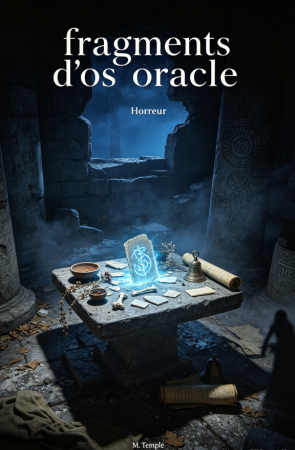
fragments d'os oracle
Auteur:Anonyme
Catégories:Mystère et surnaturel
fragments d'os oracle Introduction: Voici le dernier ouvrage de Na Duo. J'ai lu ses autres romans et je les ai beaucoup appréciés. À partir de 1911, les expériences sur les mystérieux pouvoirs intérieurs, menées par Sigmund Freud et auxquelles ont participé Salvador Dalí, Stefan Zweig et
fragments d'os oracle - Chapitre 1
This book is from , a free TXT novel download site.
For more updated free ebooks, please visit
Sleepy Valley
Sleepy Hollow, a town that has been silent for hundreds of years.
Many years later, the town became a tourist attraction, drawing crowds and bringing with it a host of strange occurrences. The arrival of a self-organized tour group sets the stage for the story of Sleepy Hollow. The group includes a psychopathic killer, a couple eloping for love, a teacher searching for his online lover, and several eccentric college students. Their reasons for coming to Sleepy Hollow vary, but a series of unforeseen events alters their plans.
The silent Sleepy Valley awakens, and mysterious deaths, deadly dangers, and the good and evil lurking deep within human nature intertwine to create a thrilling and suspenseful drama.
prelude
He moved slowly forward through the fog.
It was a strange fog, extending only from his chest forward, like a stretched-out white sheet. Above his chest, everything was crystal clear, and his vision could reach far into the distance. It was a truly strange fog; it divided the world he saw into two parts, one half clearly visible, the other half shrouded in a thick, hazy fog.
His feet moved slowly forward. He knew what he was looking for, yet he was also lost and confused. Most of his body was submerged in thick fog, with only his head and shoulders visible. He waved his hand as if trying to dispel something, and the fog swirled around his outstretched arms.
He walked slowly, so his gait had a somewhat unsteady quality. He couldn't even feel his feet moving, which made him doubt his own movement. He looked down, but couldn't see his feet; the fog was so thick it seemed to have a shape, like clouds fallen from the sky, and he felt as if he were floating on them. He looked up at the sky; the stars twinkled silently, and a crescent moon cast its cold light down. Beneath the deep blue sky, two worlds, black and white, coexisted in his vision. He thought he should be afraid of the dark, but now, the dark world was clearly reflected in his eyes, while he wondered what was hidden in the white fog.
An old tree with only two branches remaining came into his view. He wondered why it had lost all its leaves, since it wasn't winter. He walked to the side of the withered tree and touched its trunk, immediately realizing that the tree was dead. An overwhelming sadness welled up inside him and quickly became uncontrollable.
He wept in the fog, gradually forgetting his fear. He realized that all things die, and death is not a painful thing; it is a natural law. But he still couldn't stop his sorrow.
Perhaps it was only himself who was saddened.
Then he remembered that there should have been a woman by his side, a woman he loved madly, a woman he couldn't bear to see hurt by anyone. But now she was gone, leaving him alone in this strange fog.
At that moment, he finally remembered what he was looking for.
—Searching for Fang Rou.
He couldn't recall exactly how he and Fang Rou separated; it seemed like only a blink of an eye, and Fang Rou had vanished from his side. He couldn't go home alone; without a woman in his house, he would once again have to endure the desolation and loneliness of the place. That loneliness had, over the long years, tormented him beyond recognition.
Fang Rou, Fang Rou, where are you?
He continued forward, moving more gently, like a boat sailing on water, or a fish swimming in the water. Then it seemed a wind picked up, blowing the fog up and blurring his vision. He carefully discerned the direction of the wind, and suddenly, a two-story building with a wide ridge and upturned eaves appeared before him.
The small building appeared very suddenly, as if it had been following him all along and now suddenly appeared in front of him. He stared at the building; its lower half was hidden in the mist, but he could still feel its solid and heavy structure. The exposed blue bricks, due to their age, had turned a dark color. The windows of the building had patterned frames, and the glass was covered with colorful paper, from which a faint light shone through, making the paper appear even more vibrant.
He walked to the door, which consisted of two vermilion wooden doors with two animal-shaped rings hanging above them.
He tried to knock, but the door creaked open by itself, the sound echoing eerily in the silent night. He peered inside, but it was pitch black and he couldn't see anything. Just as he was hesitating whether to go in, he heard Fang Rou calling from inside.
It was Fang Rou's voice. He listened intently for a moment, but couldn't make out what she was saying. But hearing Fang Rou's voice was enough. He stopped thinking about it and strode across the threshold.
There was no fog in the room, and the darkness inside vanished the moment he stepped in.
Candlelight flickered, many candles lit up the room, casting shadowy shapes all around, but the center was brightly lit. The moment the candlelight came on, he breathed heavily, feeling as if his blood had frozen instantly, and a chill rose from his feet, rapidly chilling his entire body.
What did he see inside the house?
Women. Women everywhere. Naked women. Women lay sprawled on the ground, dark liquid slowly flowing down their snow-white skin.
He stopped in his tracks in horror, now certain that the women in the room were all dead. But they had clearly been dead for a short time; their features were still vivid, their skin had not yet turned blue, and the slowly flowing blood seemed to still be warm.
His body stiffened, his heart gripped by immense fear. He didn't know whether to continue forward or leave the house. But then, Fang Rou's sobbing echoed from inside. He immediately looked around, trying to pinpoint the source of the sound, but it was incredibly faint, seemingly both beside him and far away.
He was at a loss, his forehead was covered in sweat, and his legs felt as if they were weighed down by a thousand pounds, making it difficult to move even an inch. All he could do was shout Fang Rou's name loudly, loudly, with all his might.
—Fang Rou! Fang Rou! Where are you?
His call was met with even sharper screams, and he stared wide-eyed, hardly believing his eyes. The female corpses on the ground slowly rose, and the screams erupted from their mouths. The naked corpses approached him, and he could clearly see deep cuts on their smooth, white skin, severing their chests and abdomens. They were now tearing open their wounds with their hands, playing with some organs. Their eyes, without exception, gleamed green as they stared at the man before them, some chuckling as they approached him step by step.
He felt an uncontrollable force, and some liquid flowed down his trouser leg.
He tried to escape, but couldn't move. He wanted to scream, but a pair of cold hands had already gripped his neck. He was surrounded by a multitude of female corpses. A sticky mass was thrown at his face; he recognized it as a still-beating heart. More organs were thrown at him; he covered his face with his hands, but couldn't stop them. Many hands gripped different parts of his body; he could hear the sounds of his bones breaking and his muscles being torn apart.
His eyes were closed, and a crimson color had filled them.
Finally, he felt a sudden chill in his chest, a powerful force tearing at his body. After the excruciating pain, he could feel his heart being ripped out. He became a heartless person.
Those pale, cold hands were still tearing at his body, ripping off pieces of muscle and tossing them aside.
He endured the pain and the overwhelming fear, struggling to break free from them, but those hands lifted him up and threw him away heavily.
The descent took longer than he expected; he kept falling. He could feel the wind rushing past his ears and the flickering of light...
He woke up to find the blankets soaked with sweat.
The night was still, the wind had died down, and he stared in the darkness with terrified eyes, as if trying to figure out where he was, or as if he was relieved to have escaped from a nightmare.
After a long while, he let out a long breath and felt relieved. It was just a dream. Although the contents of the dream were still vivid in his mind, a dream is just a dream. When you wake up, the contents of the dream no longer exist.
He remembered Fang Rou from his dream, and immediately turned around, staring at the woman sleeping beside him.
Fang Rou was sleeping peacefully, her slightly pale face serene. She was a beautiful young woman with delicate, fair skin, pretty eyes, and long, smooth, lustrous hair on her pillow, though slightly disheveled.
He reached out and smoothed her hair, then his hand touched the woman's face.
"Fang Rou, I will never lose you, never." He murmured, his hand gliding across the woman's cheek and landing on her neck. He leaned down and kissed her.
Fang Rou seemed to be fast asleep, completely unaware of his caresses.
He was gradually becoming aroused, and his hand reached under the covers to caress her breasts. The woman's breasts were cool, yet incredibly soft. He had once been utterly infatuated with Fang Rou's breasts, even enjoying holding them in his palms while sleeping. Now, they were stirring in his palms again.
He smiled. Fang Rou was truly lying beside him now. What did he have to worry about?
He continued kissing the woman, his hand slowly moving downwards.
Suddenly, he stopped moving, his brows furrowing instantly.
He slowly lifted the blanket, and Fang Rou appeared naked before him.
On Fang Rou's exposed lower abdomen, there was a long wound, so ugly it looked like a snake, crooked and twisted as if it was about to swim away.
He was filled with terror as the scene from his dream reappeared before his eyes. His gaze darted around, and by the moonlight, he saw that the table beside the bed was covered with bottles and jars. He remembered that the bottles and jars contained Fang Rou's internal organs.
At that moment, all the memories became clear.
He realized that Fang Rou was actually dead, and that he had personally dissected her body.
The First Earthquake
Chapter 1 I want to leave this city
He originally planned to pick Tang Wan up from get off work that evening, take her to a hotel called "Music Kitchen" for dinner, and then take a walk on Haiyun Street. If Tang Wan wasn't tired, he would take her to a disco for a few hours, and finally, take her home.
He stood on the sidewalk opposite Tang Wan's company, feeling particularly dejected. In a large travel bag at his feet lay all his current belongings—a few changes of clothes, toiletries, a pack of Redwood cigarettes, a multi-purpose Swiss Army knife ordered online, and some odds and ends.
The thought of boarding a train heading west and leaving the city early the next morning filled him with a deep sadness.
He had lived in this city for twenty-three years, knowing it as well as the clothes he wore. He hated the city's ever-increasing number of skyscrapers, their ever-growing splendor and pretentious airs. Walking into these buildings, he often felt suffocated. In the shopping malls, so many people rushed by, the saleswomen's faces plastered with a thick layer of smiles, and most of the merchandise on the shelves was all show and no substance. He had visited Tang Wan's company a few times; a large office, divided into many small cubicles, where Tang Wan, like everyone else, lived in a cramped space.
His face showed a look of utter despair.
That evening, Tang Wan said with a smile, "What's so strange about that? Do you know how many people want that cubicle? Working in a cubicle is a dream for so many people." He shook his head without saying a word, knowing that what Tang Wan said was true, and thus felt a little sad.
He and Tang Wan were from two different worlds. He didn't know if working in a cubicle was what constituted being a white-collar worker in the city, but he knew Tang Wan earned a high salary every month, and her job only required sitting in front of a computer. She could dress herself up beautifully every day, wear the most fashionable clothes, and go to beauty salons, gyms, bars, and nightclubs in her spare time. This lifestyle initially really tempted him, and with Tang Wan's encouragement, he also tried to enter that kind of life. But it didn't take long for him to realize that if it's not your world, you can never enter it.
This is a realistic world that sets a life trajectory for everyone. To break free from this order of life, you need to endure too much hardship and suffering.
Tang Wan initially tried to introduce him to her circle of friends, but he would always do something inappropriate. Tang Wan didn't take it to heart, but he couldn't stand it anymore.
"We live in different worlds, and our meeting is just an occasional intersection of two straight lines," he said painfully. "Perhaps I will never be able to enter your world." "What does it matter? Everyone has their own way of life, as long as they are happy," Tang Wan said with a smile. "Since you can't enter my world, then I'll enter yours." What is his world?
The first time he took Tang Wan to that rooftop, standing high above the city, the entire cityscape unfolded before them. The city's layout was immediately apparent: the eastern district nestled against a not-so-high mountain range, its skyline a breathtaking panorama of towering skyscrapers. Bathed in the glow of the setting sun, they resembled a group of elegantly dressed ladies, flaunting the city's allure. The crisscrossing roads resembled taut ribbons, always appearing starkly white yet majestic. In the northwest district, old-style tenement buildings and dilapidated bungalows were haphazardly piled together, their weathered surfaces faded by time, displaying varying shades of somber gray. The crisscrossing alleyways and lanes resembled veins, chaotic yet interconnected.
He pointed to the alleyways and said, "That's where I grew up." His father was an alcoholic, and his memories of his father were of returning home drunk late at night, the crisp sound of a porcelain basin being overturned in the yard, and his endless arguments and fights with his mother. Back then, whenever his father beat his mother, he would habitually sneak into the yard alone, listen to his father's curses and his mother's cries, and timidly curl up behind an old gardenia tree.
The gardenia tree had been growing in the yard since he could remember. Before he was sixteen, its branches and leaves were taller than him. The gardenia tree was one of his fondest childhood memories. He remembered that every summer morning, tiny white blossoms dotted the lush green leaves, and the intense fragrance filled the entire yard. On summer mornings, he would often pick many gardenias and hide them in his schoolbag to take to school. The proudest girl in his class would smile at him because of the gardenias.
Tang Wan disliked gardenias because every summer morning, suburban women would sell these cheap flowers at street corners. Anyone in the city could buy a few for a few cents and pin them to their collar or chest. Tang Wan was someone who sought to be different, so she disdained having gardenias in her life. If she wanted flowers, she would ask him to accompany her to the florist to buy expensive carnations, calla lilies, lilies, and other flowers he couldn't name.
His differences with Tang Wan are evident in many details of their lives.
The gardenia tree disappeared the year he graduated from high school. When he returned home, he saw that where the gardenia tree had once been, there was only a large pit left, with some soil still around it. His father had sold the gardenia tree for three hundred yuan, and that evening he bought two jin of pig's head meat and a bottle of Yanghe Daqu liquor, and was drinking alone in the main room.
In his memory, he should have been filled with anger that evening, but in fact he just stood by the pit, silently grieving for a while, before going back into the house.
My parents have been laid off for more than half a year, and our family is struggling financially. Flowers are a luxury for poor people; they are far less practical than three hundred yuan, or two pounds of pork head and a bottle of Yanghe liquor.
After graduating from high school, he began wandering the streets. His idol at that time was to become a street hero like Hei San. Hei San was a prominent figure in the Northwest District; he spent his days leading a group of street youths, wielding weapons and helping business owners solve problems they couldn't handle. During that time, he followed Hei San, practicing boxing. After two years, although he didn't become much more muscular, he developed a muscular physique. Wherever he stood, a slight swing of his arms easily conveyed a sense of power.
Hei San was sentenced to death at a public trial on National Day in 1997. When he stood in the prison van parading through the streets, he had lost his former heroic air and needed two armed police officers to support his arms to keep his balance.
That time, he learned that Hei San was responsible for several murders.
Hei San is a thing of the past; new street kids quickly took his place.
In the same year that Hei San was executed, he realized that there are no true heroes in this world, and that the actions of a hero, under certain circumstances, are actually a deep sense of helplessness. He began to keep a low profile, whereas before that, his name was enough to inspire awe in many young people just starting out.
He needs to find a new way of life to fill all those boring hours each day.
He changed jobs many times, but never stayed long. There were always various reasons that made him leave the places he had just become familiar with. He delivered gas at a gas station, but after only two weeks, a customer came knocking on his door after money was stolen from their home. He worked as a material handler at a construction site, and on the fourth day, he smashed a middle-aged man's nose. He worked as a security guard at a residential complex, and after everyone worked together to catch two thieves, he secretly released them…
He didn't hide any of this from Tang Wan after they met, but Tang Wan didn't care. Tang Wan knew that he would never take money from customers' homes when delivering gas. He smashed that guy's nose at the construction site because the guy bullied him because he was new. As for letting the two thieves go without permission, it was because those two thieves used to be his buddies.
Outside of the larger social order, almost everyone has their own set of behavioral norms. Sometimes, these two sets of norms are contradictory, but you cannot simply use them to judge good and evil.
Tang Wan is an extraordinary girl. Her vision can see beyond the surface of things and reach the essence. That's why she fell in love with him despite the opposition of her family and friends.
He always harbored some doubts about Tang Wan's ability to fall in love with him. Of course, he didn't doubt Tang Wan's feelings, but rather felt incredibly lucky that such a scenario, which should only exist in fairy tales, could actually become a reality.
However, his love with Tang Wan was destined to be unlike that of ordinary people, which was not smooth sailing.
Tang Wan's family learned of his existence and strongly opposed her relationship with him. Tang Wan refused, so her father picked her up from work every day after get off work and kept her locked up at home during his days off.
Tang Wan was a clever girl who often came up with quirky ideas to get away from her father. As a result, Tang Wan's relationship with her parents became very strained, and every day when she returned home, she would lock herself in her room.
If Tang Wan's parents were the unreasonable, boorish type, he might not have cared. But he witnessed the elderly couple, their hair streaked with gray, looking somber before him. After a righteous and stern rebuke, the old woman pleaded with him to spare her daughter, while Tang Wan's father stood by, chain-smoking, his back seemingly hunched over in an instant. At that moment, he was torn. He couldn't bear to hurt the elderly couple, and he was even more unwilling to lose Tang Wan.
It was Tang Wan's insistence that made him make up his mind.
As he had predicted, Tang Wan's parents seemed even more determined than he was; they resolutely refused to allow someone like him to become their son-in-law. They were people of status in the city, and they couldn't allow someone from the lowest rungs of society to tarnish the social image they had painstakingly cultivated.
The story unfolds in accordance with our imagination from movies and TV dramas; a series of events push him to the edge of a cliff.
He was living in a rented bungalow at the time. After a knock on the door in the middle of the night, several dark figures stood in the darkness outside. His life on the streets had made him unafraid of anyone's malicious provocation, but that night he faced not fists, but a stack of banknotes.
The money was his reward for leaving Tang Wan.
It was windy that night, and the banknotes began to flutter and dance in the air. He stood by the door, a surge of anger rising within him. If his enemy had stood before him, he would have charged at them without hesitation.
But those dark figures represented Tang Wan's parents, and he had nowhere to vent his anger.
Another late night, after breaking up with Tang Wan, he returned home to find several uniformed police officers already waiting for him in an alley. Tang Wan's father wielded considerable power in the city; a mere use of his authority would be enough to kill him.